


Are you a photographer considering a trip to Galapagos and wondering what it will be like? This page is for you; I've been three times and am sharing my experiences here. I've taken photos like the ones in the (clickable) thumbnails below, or see my gallery (or the slideshow version).
You live aboard a ship. A typical day:
| Time | Event |
| 5:30 | breakfast on ship |
| 6:00-10:00 | a shore landing for animal/landscape viewing |
| 10:30-11:30 | snorkeling or panga ride or kayaking |
| 12:30 | lunch, then a break; ship may travel to nearby destination |
| 14:00-18:00 | another shore landing (and maybe snorkling) |
| 18:30 | dinner aboard ship, followed by a presentation by the naturalist or photographer |
| 24:00 | ship starts cruising to the next island |
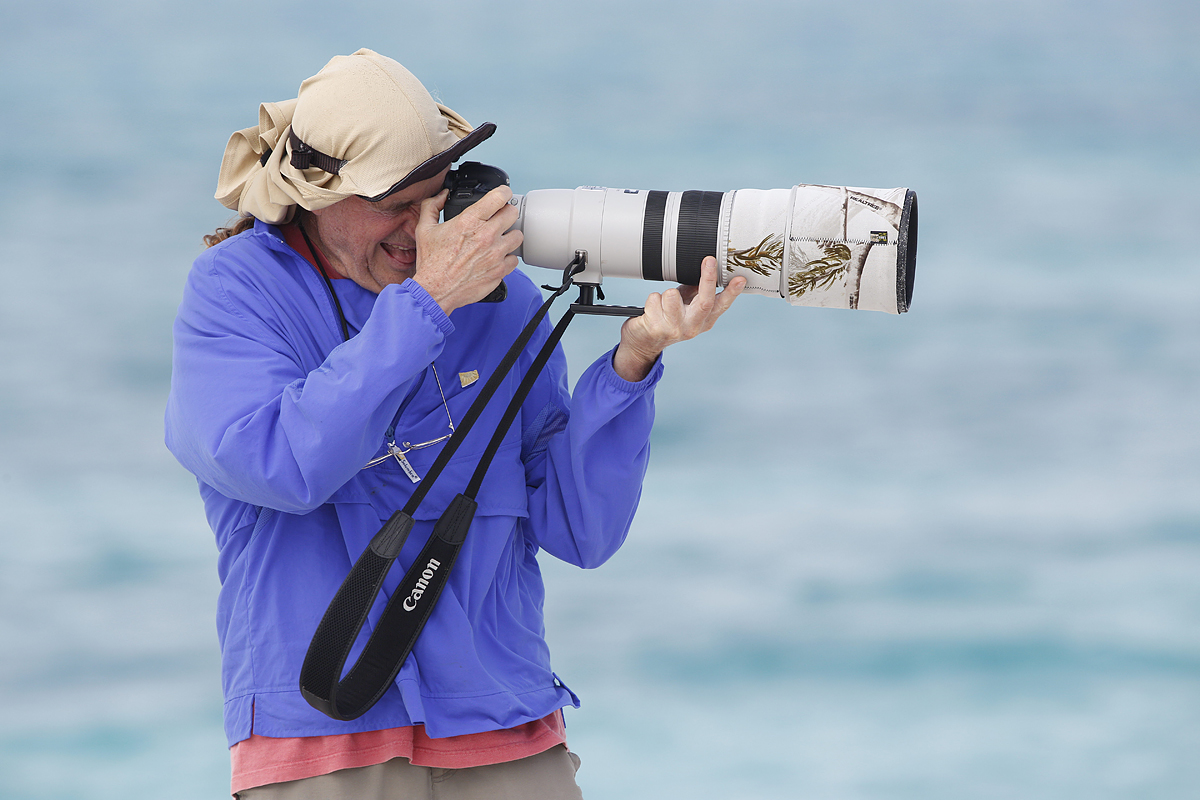
There are  naturalist tours and photographic tours. If you're on this page, you're probably a serious photographer, but even if you are not, I still recommend the photographic tour. First, because you just see more on a photographic tour. The photographer will have you out on the island at 6:00 AM to catch the first attractive morning light; the naturalist will assume you would prefer to sleep later, and thus spend less time on shore with the animals. Once on land, the naturalist guide wants to keep things moving, while a photographer guide slows things down, allowing you to spend more time at each site. And second, because our photographer guide, Tui de Roy, was fantastic! Tui (pictured at right with a tour member) arrived in Galapagos at the age of two when her parents decided to homestead there; she has spent most of her life exploring, playing, understanding, and photographing the islands. Her multiple books establish her as the premier Galapagos photographer. It's like taking a tour of Yosemite with Ansel Adams.
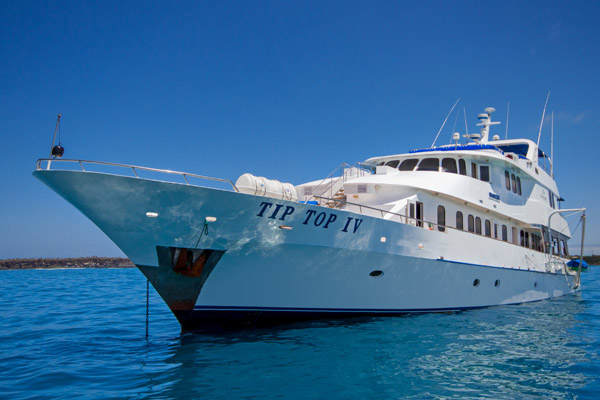
We were on the 16-passenger Tip Top IV. I would avoid the large 100-passenger cruise ships. Here's our ship and a panga (aka zodiac boat) used to transport us to shore:

Ships in Galapagos are assigned a 14 day strictly regimented island-by-island route by the Galapagos National Parks Service. Tour providers can package this as one two-week tour, two one-week tours, or whatever. Here is our two-week route with Galapagos Travel.

What will you see, and where? Check out this map, or a similar one at the bottom of my gallery:
Here's what I brought on each trip. I used Canon gear, but if you have a similar setup (camera, long lens, and wide lens) from Nikon, Sony, Fuji, Olympus, or Panasonic then don't worry, you'll do fine.
| Equipment | 2008 Trip | 2014 Trip | 2019 Trip |
|
|
|
|
|
| Camera: | Canon 5D | Canon 6D | Canon R |
| Wide lens: | 17-40mm f/4 | 16-35mm f/4 | 16-35mm f/4 |
| Long lens: | 100-400mm I | Tamron 150-600mm | 100-400mm II |
| Underwater: | Canon G9 | Sony RX 100 | GoPro |
|
|
|
|
|
| Backup Camera: | Canon G9 | Canon 7D | Canon 7D II, Pixel 3 phone |
| Shared lenses: | 24-105mm | 24-70mm 70-300mm L |
70-200mm f/2.8 400mm f/4 |
|
|
|
|
|
For the 2014 trip, each day I would carry one long lens (150-600 more often than 70-300) and one wide (16-35 more often than 24-70).
On the 2019 trip some days I would have the 100-400mm II and my wife would have the 70-200mm, other days we would swap. Some days I also carried the 400mm f/4. The 16-35mm was my only wide lens (except for my cell phone).
I never carried two cameras at a time with lenses attached; I felt that would be cumbersome with all the scrambling over rocks. I generally kept the long lens on the camera (just in case there was some action in the distance I wanted to quickly capture) and when it was time for a wide angle shot I would change lenses, get the shot(s), then change back. I was very glad to have backup equipment (shared between me and my wife) back in the cabin for variety's sake, and in case anything broke (even though nothing did).
Below are charts of the focal lengths of all the shots that I considered the best from each trip, broken out by lens. For each trip there are two charts, one for actual focal length as recorded in the EXIF data, and one for 35mm-equivalent focal length after cropping. By that I mean, if the focal length on the lens is set at 200mm, but I crop the photo down to half the size in both vertical and horizontal directions, then the equivalent focal length is 400mm. This tells me what focal length I wanted to have when I was getting the shot, not what lens I happened to have in hand.
In the charts below, each mark corresponds to one of my best shots: the x-axis position gives the focal length, and the color gives the lens, as defined in the legend. For example, the 14 blue dash-marks in the lower left corner of the first chart (2008) correspond to shots taken with the 17-40mm lens; 9 of them are at 17mm, and then 5 at longer focal lengths. There are just 3 orange marks for the 24-105mm lens (the backup that I used just one day), and 57 green marks for the workhorse 100-400mm lens; we see that many of the shots are right at the 400mm long end of the lens. In the next chart, we see that many of these 400mm shots have been cropped to longer focal equivalents; some past 800mm. A similar pattern holds for the 2014 and 2019 trips: whether my zoom goes to 300, 400, or 600mm, there are many times when I want to go longer. In the final two charts, all the shots for all lenses over all trips have been combined.

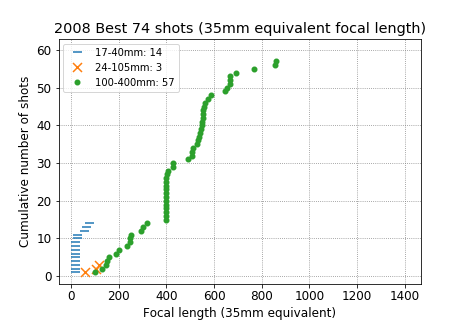
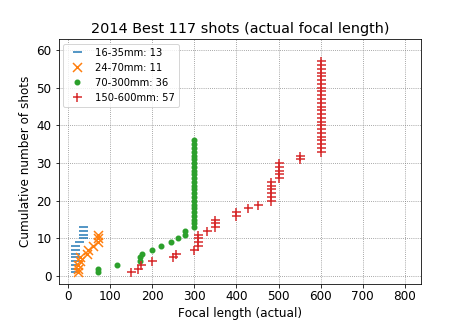

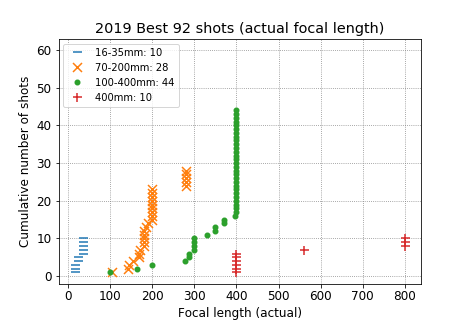

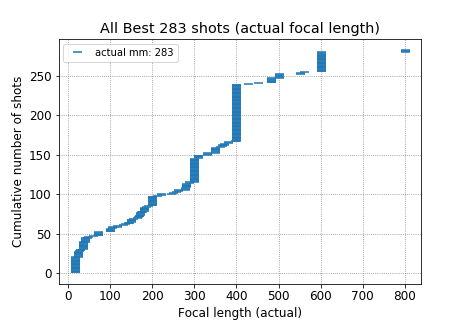

For me, covering the 24-300mm range would not have been enough (whether with a single superzoom or with two lenses, 24-70mm and 70-300mm). 6% of my best shots were wider than 24mm, and fully 50% were longer than 300mm.
The animals in Galapagos are famously tame; you can walk right up to them. Indeed, at times you have to be careful not to step on them. So why do you need a long lens? Well, as Thom Hogan points out, "It's not a matter of not being able to get close to the animals. Instead, it's a matter of getting close to the animals when they're doing something you want to capture." Since you're not allowed to go off the trail, and since the interesting action might be farther away and fleeting, you need a long lens to capture it. Also, if you want a nice portrait of an animal you'll want a long focal length to eliminate distracting elements (brush, sky, other animals, tourists), and a wide aperture to blur out the background. On the other hand, you will be walking around for hours, so you want something that is not too big and heavy to carry.
The following table compares four choices for the Canon system (other brands have similar offerings). I give the lens, its maximum aperture (f), minimum focus distance (MFD), DxO Mark overall image quality score (which is suggestive, not definitive), retail price, weight, and appropriateness for use in Galapagos (in my opinion):
| Lens | f | MFD | DxO | Price | Weight | Comments |
| Canon 100-400mm II | f/5.6 | 3 ft | 26 | $2,100 | 1.6 kg (3.5 lb) | The best overall option in the Canon system. |
| Canon 70-300 L | f/5.6 | 4 ft | 25 | $1,300 | 1.0 kg (2.3 lbs) | High image quality, light weight, may not be long enough. |
| Tamron 150-600mm | f/6.3 | 8 ft | 19 | $1,100 | 2.0 kg (4.3 lbs) | Good but not perfect image quality, longer range, heavier. |
| Canon 70-200mm f/2.8 II | f/2.8 | 4 ft | 33 | $1,900 | 1.5 kg (3.3 lbs) | Only 200mm (or 280mm with a 1.4x TC); great in that range. |
All of these lens are very good. If you have any one of these (or the equivalent in another camera system), don't worry, you have all the tools for a successful photographic trip to Galapagos. Don't obsess over lens reviews: I never once said to myself "I wish I had a lens that was one point sharper on the DxO benchmark." But when I was carrying the 70-200mm I sometimes said "I wish I could reach to 400mm or longer."
In more detail:
Canon 100-400mm II I think this is the best overall long lens option for Galapagos (in the Canon system). Light enough to easily handhold, great focal range, excellent image quality except for a slight tendency towards fiddly backgrounds, as is expected for an f/5.6 lens. Samples:


(In photos throughout this page, you can hover to see the shooting data, and click through for a bigger version.)
Canon 70-300mm L IS: In 2014 I carried the small and lightweight 70-300mm when I knew subjects would be close and large (like sea lions) or when I wanted to be more agile (like when we were in a crowded panga trying to track diving pelicans). Samples:


Tamron 150-600mm: In 2014 I carried this when I knew subjects would be small or far away. This lens gets mixed reviews; I think the real issue is that focusing at 600mm without solid support is inherently difficult—much more difficult than at 300mm. This lens is heavy, but I had no problem at all carrying it from a shoulder sling strap and hand-holding it all day. As the focal length chart above shows, I certainly took good advantage of the 600mm range on this lens. However, I still think the 100-400mm is a better overall choice, because it (a) is smaller and lighter, (b) has better image quality in the 100-400mm range, and (c) paired with a good camera, it produces images that can stand cropping to the equivalent of a 600mm range. (Note: Tamron updated this lens in 2016, Sigma has two similar lenses, Nikon has a 200-500mm, Sony has a 200-600mm, and Canon has preannounced a 100-500mm.) Samples:


Canon 70-200mm f/2.8 II: A fantastic portrait lens; the only f/2.8 lens among the options; has the capability to blur the background better than the f/5.6 lenses. Samples:


What about the gap between your wide and long lens? If you have the 17-40mm and 70-300mm, then the 40-70mm gap is not worth covering with another lens; just take a few steps forward or back. If you have the 16-35mm and 150-600mm then you might want something in the 35-150mm gap (perhaps a 24-105mm or 70-200mm lens, or a 85mm prime, or a quality compact or mirrorless camera).
The 17-40mm and the 16-35mm both did fine. More important than the slight differences between lenses is the types of shots you can get with whatever lenses you have. You'll see an interesting animal or landscape; how should you record it? Here are some options.
We can show the expanse of the landscape at a 16mm or 17mm focal length. (A 24-70mm zoom would have cut off 1/3 of these shots.)


Capture the landscape in the background, and feature some flora, fauna, or mineral in the very near foreground:


You are not allowed to stick a camera right in an animal's face. (National Park rules say everyone is supposed to keep a 2 meter radius away from animals, except for those of us from the United States, who, in another example of US imperialism, are only required to keep 1.83 meters away. The signs call this "six feet.") However, you are allowed to sit in place and wait for a curious animal to approach:


You can sometimes get a humorous effect with the right juxtaposition of foreground and background—forced perspective makes the juvenile frigate bird look like a giant, and the fuzzy white frigate bird chick looks goofy from any angle, but this one accentuates it:


Or you can just show that the animals are in an environment that includes people in close proximity:


Some shots show what it is like to be there; there are animals in the shot, but they are not featured.

Most animals in the Galapagos are small (ok, not the whale shark); they look better if you get down to eye level. This can be done with either a wide angle lens (shoot the marine iguana with camera perched on the sand; crawl on your belly or use live view to compose the image on the LCD; so much the easier if you have a fold-out LCD) or a long lens (adopt a sitting position 30 feet from the tortoise and you will still be at eye level).


Using a longer lens you can isolate an animal, with a blurred background serving as a colorful backdrop—just enough to show that this is in the wild, not in a studio.


You don't need to show a portrait of the whole animal. Galapagos has several species with eponymous body parts, and other interesting details.


Sometimes you catch the decisive moment, like the Noddy landing on the pelican's head to hunt for the small fish that the pelican stirs up, or these two young sea lions playing.


Capturing birds in flight requires decent equipment, good technique, and lots of practice. Use continuous autofocus, with multiple autofocus assist points (zone focus). Start with large, slow-moving birds like pelicans and frigate birds. It is easier to focus on a bird against a blank sky than against a busy background, but try to include some interesting background, if only some clouds.


Next try smaller, faster, but still smooth flying birds like the swallowtail gull or albatross. I've used a shutter speed of 1/2000 sec to freeze the motion. Also work on more interesting backgrounds.


A real challenge: the small, fast, darting Tropic Bird (this one flew so close that I clipped a wing), and the Galapagos Shearwater, here shown banking frantically with its tail-feathers as it skirts the edge of the cliff:


Also challenging is getting the exact moment when a diving bird hits the water. Boobies may need a shutter speed of 1/4000 second. Put the focus points on the bird as it cruises, then fire a continuous burst of shots as it dives, trying to keep the focus point on the bird. You may be used to panning on a constantly-moving subject (like a running person or animal), but the hard part here is that the bird is accelerating—because of gravity, and with the boobies, there is extra acceleration because they actively fly downward. It can be hard to keep your camera framed on the bird.
The pelicans were diving at about 20 to 30 ft/sec. They are about 4 feet long, so if your camera shoots 10 frames/sec and if you can hold focus, you'll be guaranteed to get one shot of the bird just above the water and the next splashing. If your camera only does 5 frames/sec you'll need some luck. Boobies are smaller and faster, and depending on how high up they start their dive, can reach 30 to 80 feet per second, so even at 10 frames/sec, you might miss the key moment. Below are four examples that combined good luck with not making any big mistakes; I won't show the many, many shots that were too early, too late, out of focus, or mis-framed:


This is a great example of the advantage of the photographic tour: in 2008, the naturalist told us that it would be difficult to get a good picture of a diving bird, so we didn't spend much time even trying. Tui de Roy knew that all the photographers wanted to try, so she spent a lot of time getting us in just the right location to give us the best chance.
You're on the equator: much of the time the sun will be overhead. Try to avoid stark shadows (except for effect as in below bottom right). Look for subjects in shade, or under cloudy skies. Another advantage of the photographic tour is that you spend more time ashore near sunrise and sunset, when the light is more interesting. Do consider side or back lighting, which can either be used to highlight edges and shine through, as with the cactus and the pelican's pouch, or for a silhouette, as with the three iguana pictures, or for shadows as with the humans:


I said that the 100-400mm lens covers a great focal range. But it does have a weakness: a limited ability to blur the background. That's not really a criticism of this particular lens; it holds for other f/5.6 lenses as well. They just can't do as well as an f/2.8 lens at getting a nice smooth background. Consider the following two shots:

On the left, the 100-400mm f/5.6 lens produces a very sharp image of the iguana, contrasting nicely with the rock behind the head. But the background has various sticks that are not well-blurred; they produce a busy, unpleasing disruption. On the right, the 70-200mm f/2.8 lens produces a much smoother, more pleasing blur in the background. The quality of the blur is called bokeh. The background on the right is nicer in part because of the inherent properties of the lens, and in part because the background is farther away and consists of roundish rocks, not straight sticks.
It is also possible to blur the foreground, although this technique should be used with care lest the foreground become a distraction. Below left I have used the trick of getting down low and using a rock in the foreground very near the camera to create a wash of grey in front of the iguana. Below right I use a similar approach with a wash caused by vegetation very close to the camera; the vegetation on the left edge of the frame is closer to the frigate bird subject, and thus is not blurred.

Besides blurred backgrounds and foregrounds, another aspect of bokeh is specular highlights from reflections off of water or shiny material. Below left we see the backlit sun reflecting off the ocean; this adds interest to a photo that would be dull without the highlights. Below right we see reflections off of sparkly bits of sand and minerals in the rocks, making it look like a horde of dragon's gold (both photos are better viewed at larger size; click on them).


Below is Markus Fromherz's photo of the making of this iguana shot; I'm the one sitting with the greyish backpack; I'm composing on the fold-out screen, getting my lens close to the rock and sand in front of it. Rachel to my right doesn't have a fold-out screen, so she is lying on the ground.

Cell phones in 2019 come with quite capable cameras; that wasn't true in 2008 or 2014. They won't give you a telephoto image with a blurred background, but if you want a 28mm equivalent focal length with everything sharp, they can do the job. And it can be more convenient to quickly pull out a cell phone than to change lenses.


Many pros (e.g. Tui de Roy, Frans Lanting, Tim Laman, and Art Morris) have used heavy, expensive supertelephoto lenses in Galapagos.
But even though he sometimes carries one, Tim Laman advises that for you and me, "a good setup would be ... a 24-105mm, and ... a 100-400 f5.6." (I agree but would substitite a 16-35mm for the 24-105mm.) Andy Williams says supertelephotos "are way too heavy and difficult to handle and use on the Islands in Galapagos." Up until 2014 Tui de Roy lugged her Nikon 200-400mm f/4 on a tripod because she was not satisfied with the quality of Nikon's original 80-400mm lens. But once she got the much-improved 80-400 version II, she ditched the tripod and heavy lens, saving about 8 pounds and a lot of trouble.
For the record, here are three choices in the supertelephoto category, compared to three telephoto lens discussed previously:
| Supertelephoto Lens | f | MFD | DxO | Price | Weight | Comments |
| Canon 500mm f/4 II | f/4 | 12 ft | 31 | $9,000 | 3.2 kg (7 lbs) | Heavy; not as versatile as a zoom; expensive. |
| Canon 200-400mm f/4 | f/4 | 6.5 ft | 30 | $10,000 | 3.6 kg (8 lbs) | Built-in 1.4x TC. Perfect coverage, but heavy, expensive. |
| Canon 400mm f/4 DO II | f/4 | 10 ft | 30 | $6,000 | 2.1 kg (4.6 lbs) | Light enough to hand-hold; slightly less expensive. |
|
|
|
|
|
|
|
|
| Telephoto Lens | f | MFD | DxO | Price | Weight | Comments |
| Canon 100-400mm II | f/5.6 | 3 ft | 26 | $2,100 | 1.6 kg (3.5 lb) | The best overall option. |
| Tamron 150-600mm | f/6.3 | 8 ft | 19 | $1,100 | 2.0 kg (4.3 lbs) | Inexpensive, good but not perfect quality, heavy. |
| Canon 70-200mm f/2.8 II | f/2.8 | 4 ft | 33 | $1,900 | 1.5 kg (3.3 lbs) | Fantastic lens. 100-280mm f/4 with a 1.4x TC. |
We see that the supertelephotos cost 5 or 10 times as much, weigh around twice as much, are a stop or two faster, and have image quality that is maybe 15% better. If you own a supertelephoto lens, you presumably know exactly what you're doing and you don't need any of my advice. But if you are considering something to rent for the trip, I would still recommend the 100-400mm II, which is easier to handle, covers a wider range, and has image quality that is nearly as good. But judge for yourself: would you be comfortable shooting like Art Morris (below left) or Tim Laman (below right), knowing that your pack would be 15 pounds heavier and your wallet $12,000 lighter? (Note: Art has been know to carry the 200-400mm, the 400mm DO, the 500mm, the 600mm, and even the 10 pound 800mm in Galapagos. He can make great photos with just about any lens that is big and white and has an affiliate link.)

For me (in Galapagos) I only want a lens I can comfortably hand-hold, so the only supertelephoto I would consider is the 400mm f/4, which I did bring in 2019. It can nicely blur the background: check out the sand around the mockingbird below left; a much better performance than the f/5.6 lens used for the mockingbird below right:


The 400 f/4 only weighs one pound more than the 100-400mm, so the issue is not so much the weight of the lens itself, rather that with it I also carry a teleconverter, my wide lens (16-35mm), and because the 400mm is not a zoom, I need something in between, like the 70-200mm. That means I need a hefty backpack to carry everything, rather than just a belt pouch for one spare lens. So I ended up taking the 400mm lens only on days when I knew it would be especially useful. (One thing that discouraged me from using it more often is that on the first day I got a persistent spot of dust on my sensor; from then on I tried to minimize the number of times I changed lenses, and so preferred zooms over a prime.)
The only three key things you need to cover are wide, long, and wet, but there are some exotic options to consider:
Below is a panoramic made with Lightroom photo merge, a near-macro of a bee from the 100-400mm lens, and some diatoms in the microscope (courtesy of Steve Mandel):


This is easy: if you already have a recent interchangeable lens camera (DSLR or mirrorless, full-frame, crop or micro-4/3, any manufacturer) you'll be fine. Don't worry about it. (OK, I admit a higher-end camera does give you a slight advantage for fast-moving birds in flight, but that's the only circumstance on Galapagos where your camera might limit you.) Below are four setups: a full-frame Canon DSLR with 100-400mm lens (similar to what I used); a full-frame Sony mirrorless with 100-400mm lens (similar to what my friend Steve Mandel used in 2019 and let me borrow a few times—I found little difference between the Sony and Canon systems); a micro-4/3 camera (whose sensor is about 1/4 frame) with a 100-400mm equivalent lens; and, for comparison, a non-interchangeable-lens bridge camera (the Sony RX10, whose sensor is about 1/7 frame) with a 24-600mm equivalent zoom. You can also see a comparison of smaller, less expensive APS-C options.

Let's face it, if you've read this far through this techno-geeky page, you're probably not the kind of person to trust your photos to a bridge camera. But if you (or other people in your party) are, take a look at this trip report from Point & Shoot Nature Photographer and see if results like the tropic bird picture below left, taken by Steven Ingraham with a Sony RX10, are satisfactory. If you don't look too close, there's not all that much difference between bridge and full-frame:
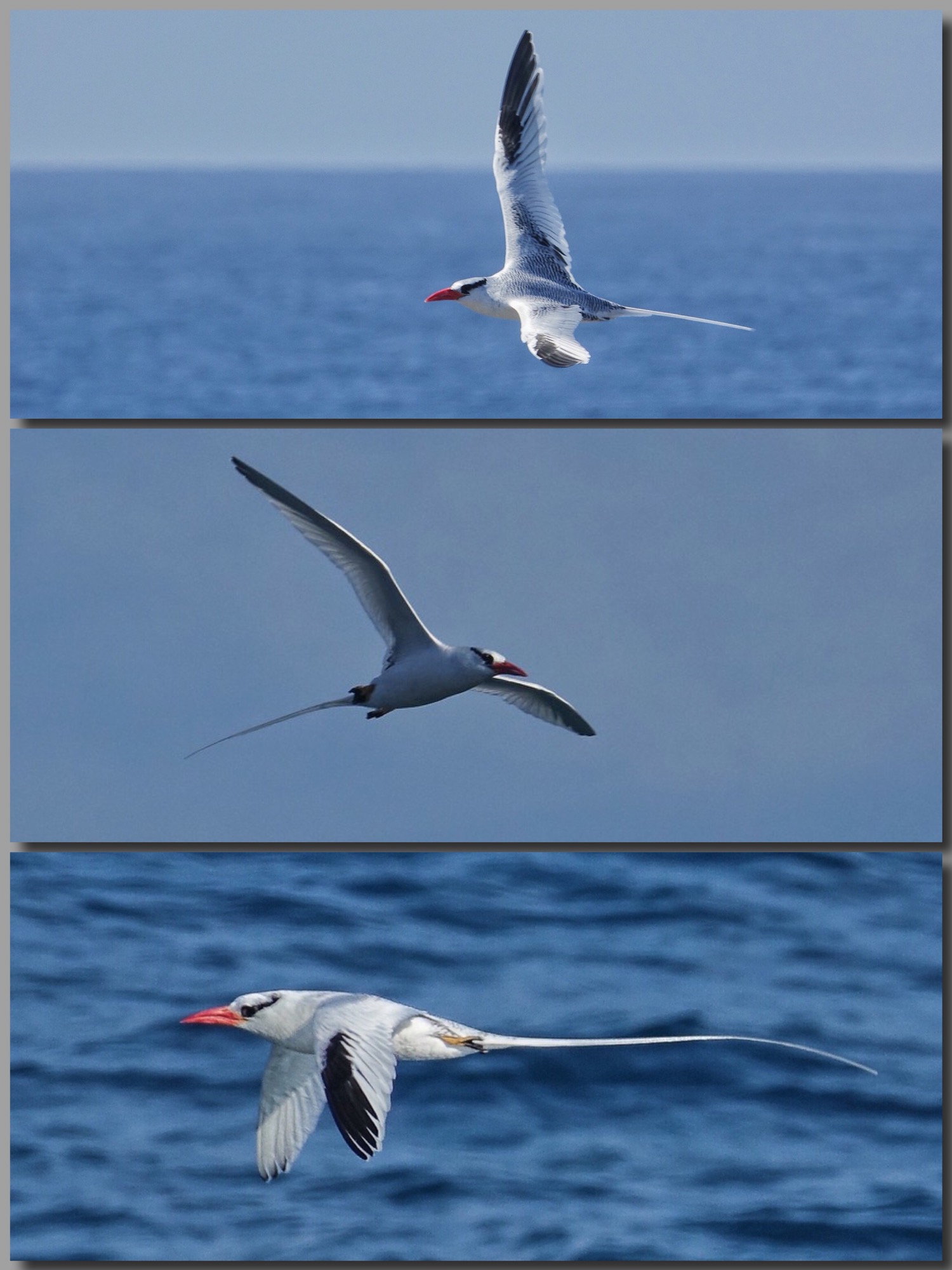

But with the bridge camera, that's about all the detail you get (at least from this particular shot), whereas the full-frame camera has a lot more detail when you zoom in:

Once or twice a day you will have a snorkeling opportunity. You will see many fish, playful sea lions, sea turtles, sharks, and probably penguins and marine iguanas in the water. People on our trip had different approaches. Some chose to enjoy the experience without bothering with pictures; some brought a GoPro (great for video); some brought a waterproof camera; some had an underwater housing.
I have two suggestions for underwater: first, shoot mostly video, not stills. Video is more forgiving of bubbles or particles in the water and of slightly blurred subjects. Second, the most important thing for good underwater pictures is not the choice of camera, but the ability to dive down 5 to 15 feet, get your camera at the level of your subject, and stay there long enough to frame and take your shot or movie. So don't spend time comparing underwater camera options; spend it practicing holding your breath and moving under water. You typically wear a wetsuit in Galapagos which makes you buoyant, so ask your tour operator ahead of time to stock a weight belt for you, to make you more neutrally buoyant. Bring your own wetsuit or arrange ahead of time to rent one.
Ads for Galapagos trips frequently mention trip of a lifetime, so if I've been three times, am I a cat working on nine lives? No.