
| This page is for 2008 Election
Click here for 2012 election |
This is an FAQ (Frequently Asked Questions list) for the 2008 United States Presidential Election. I need to disclose up front that I am an Obama supporter. However, with the exception of the very last question, this FAQ is designed as a collection of factual information (such as the latest poll results) and of analysis that is as objective as possible.
To track who is winning in real time on election day, watch first for the betting markets (such as Intrade, or this tool for watching Intrade, and later in the day look for election result news.
Wanna bet?
Recently there has been much interest in prediction
markets. The idea is that if people bet real money on an outcome
(such as the presidential race), they may have more honest and more
considered opinions than typical poll results. There are at least 5
markets covering the election; here are the current numbers from the
Democratic Party point of view, expressed as a probability of
winning:
For interesting commentary on political futures markets, see Worlds of Spike. Justin
Wolfers has a WSJ
article that covers the "favorite-longshot bias" -- the idea that
people bet too much on longshots. You can see this at horse races,
and it is clear why it happens: if a horse is a 20-1 longshot, bettors
say to themselves "if this one pays off, I'll be rich!," potentially
changing their lifestyle, whereas if they go with the favorite, their
payoff will be much more modest. Wolfers says that if you adjust for
the longshot effect, then the prediction markets, which currently are
at about 85% for Obama, are actually suggesting a 96% win probability
for Obama, which is just about the same as Nate Silvers at 538
predicts.
What does McCain have to do to win?
| In the chart at right from Pollster.com, we
see Obama currently with 364 electoral votes (the number in blue just
above the black horizontal dvividing line). McCain has to move the
dividing line up the chart until Obama is below 269. Let's say that
there is a general 3% voter shift towards McCain (due to systematic
error in pollster's assumptions). The 3% would mean that McCain gets
North Carolina, Missouri, and Florida. The dividing line has moved
up, but Obama still gets 311 electoral votes. A 5% shift nets McCain
just one more state, Ohio, and Obama still has 291 electoral
votes. Even if the shift were 7%, Obama would still get 278 electoral
votes and remain the (close) winner. But if McCain gets a 7.3% shift
and wins Nevada and Pennsylvania (as well as the five other
battleground states that are less against him, and the four toss-up
and two leaning states that favor him), then McCain would squeak out a
win. Could McCain get 7.3% more than expected? It would take a huge
error in the pollsters's models.
Another way to look at it is from the top of the chart down: Obama has 238 electoral votes with a margin above 10%. So he needs 31 electoral votes from the nine states that are leaning his way or the six that favor McCain. If you count New Mexico, with its 8.9% margin as almost certain, it's down to 26. If Obama holds Pennsylvania, he would only need one more state from the remaining thirteen (except Montana and South Dakota are each too small). So think of like this: Obama needs any one of eleven states, or both of Montana and South Dakota. If each state were a 50/50 coin toss, McCain's chance of winning would be 0.04%. Clearly, for McCain to win he'd need a systematic error in the polls, not just random fluctuation. The other big problem facing McCain is that many of the votes have already been cast, and they favor Obama by a 59% to 40% margin (according to polls, not official tallies). Stan Greenberg has a nice analysis that comes to a similar conclusion. Republican-leaning pollsters John Zogby and Frank Lutz agree: Zogby says "it is hard to see where McCain goes from here" and Luntz says "I don't see that there is any way at this point for John McCain to win." Nate Silver gives McCain a 2.8% chance; that sounds about right to me. | 
|
| Podhoretz's 10 Reasons Why McCain Might Win | My commentary |
| 1) One poll has undecided voters at 14 percent on the last weekend, which means most of them probably really aren't undecided, that they are either going to stay home or vote preponderantly for McCain and pull McCain across the finish line. | 1) As we've seen before, looking at one poll is the worst possible thing to do. If we look at the 9 tracking polls today, we see that McCain trails by an average of 6.3%, and that there are 5.4% undecided on average. Even if McCain got 100% of the undecideds, he'd still be behind. But nobody thinks he will get 100%. Most think he will get more than half; Some think he might get a 2-1 margin; but the most recent speculation, such as by Pew's Andy Kohut and an ABC/Washington Post poll predicts a much closer split, with McCain getting maybe 55% to 60% rather than 67%. |
| 2) Most pollsters are claiming the electorate this year is six to nine points more Democratic than it is Republican. That would be an unprecedented shift from four years ago, when the electorate was evenly divided, 37-37, Republican and Democratic, and a huge shift from two years ago, when it was 37-33 Democratic. A shift of this size didn't even happen after Watergate. | 2) Pollsters are not making that claim because they are biased liberals; they make the claim based on data, data, data, and more data. Analysts take the polling data and actual registration data (where known), along with their own models for how to interpret the data, and most come up with numbers that are, as Podhoretz says, around a 37% to 28% edge for the Democrats (the rest are independents). There are some polls that put the edge closer to 4% or 5%, so Podhoretz might be right. This story says the shift is not only bigger than anything going back to Watergate, it is, at least in Nassau County, a shift that is unprecedented in 110 years. If, as Podhoretz points out, we had a 4% shift in two years, it does not seem unreasonable that there could be another 4% in two more years. I agree that getting party ID right is important for doing polls properly. Much of the difference between the polls that have Obama up by 5% and the polls that have him up 10% come doen to party ID. But none of the polls give McCain the last 5% he would need to win. |
| 3) Obama frequently outpolled his final result in primaries, which might have many causes but might also indicate that he has difficulty closing the sale. | 3) OK, if "frequently" means more than once, but not if it means "usually." This study shows that Obama's state primary margin with respect to Clinton was higher than the last polls about half the time, and that about 70% of the time, the candidate who was leading in the last poll ended up increasing his/her lead. This suggests a bandwagon effect more than anything about Obama (or Clinton). This study, although it only covers 8 primaries, shows that although Obama sometimes had a lower margin over Clinton than predicted by the polls, in every single case he increased his share of the vote (by taking share from other candidates). |
| 4) The argument in the past two weeks has shifted, such that many undecided voters who are now paying attention are hearing about Obama's redistributionist tendencies at exactly the right moment for McCain. | 4) Perhaps, but only 37% of voters think that redistributing is a bad idea. In general, most voters agree with redistributing from the wealthy to society at large in a way that benefits the middle class, and disagree with redistributing from the middle class in a way that benefits the poor. Obama's policies stress the former, but may be interpreted as the later; that would indeed hurt him. |
| 5) The tightening in several daily tracking polls indicates a modest surge on McCain's part that could continue through the weekend until election day. If he is behind by three or four points right now, a slow and steady move upward could push him past the finish line in first place. | 5) First, today's polls can be interpreted as either a widening or as random fluctuation, but not as a tightening. Second, McCain is behind by 6 or 7 points now, not 3 or 4. Third, "a slow and steady move upward," if it were as fast as any move in this campaign, would leave him about 5% behind. |
| 6) In terms of the electoral map, the energy and focus McCain is directing at Pennsylvania could pay huge dividends if he pulls it off. If he prevails there, it might follow that the message will work in Ohio too. And if he wins Pennsylvania and Ohio, he will probably win even if he loses Virginia and Colorado. | 6) Actually, if you move PA and OH to McCain's column, he gets about 220 or 230 electoral votes, according to most pollsters. Even if you add FL, he still falls short. Nate Silver does not offer odds on what happens if McCain wins PA and OH, but he does calculate that if McCain wins PA, he only has an 11% chance of winning the election, and if he takes FL and OH, 25%. But checking back with reality: in the last ten days McCain has made good progress in PA, moving from 13% down to 8% down, but at that rate he would need three more weeks to catch up. |
| 7) Early voting numbers are not oceanic by any means, which may indicate the degree of enthusiasm for Obama among new voters is not something new but something entirely of a par with past candidates, like John Kerry. And they show more strength on the Republican side than most people expected. | 7) Early voting has favored Obama by a 59%-40% margin. Or by 58%-42%, take your pick. Traditionally, (including 2004) early voting favors Republicans. Many counties have already surpassed their 2004 early voting levels, and there is a week to go (from when those numbers were collected). Nationwide, 17% have voted early, and 18% said they intend to, for a projected 35%. Early voting levels were 22% in 2004 and 15% in 2000. I don't know if that counts as "oceanic," but it looks like early voting is up by about 50%, and that it heavily favors Obama. In some states, such as North Carolina and Georgia, early voting is double the 2004 level, and is Democratic by almost 2-1. In Florida, Democrats are over 60% of the early voters; in Colorado, Democrats hold a slight 3% edge. See George Mason University's summary of early voting. |
| 8) What happened with the Joe the Plumber story is that Obama has now been effectively outed as a liberal, not a moderate; and because liberalism is still less popular than conservatism, that's not the best place for Obama to be. | 8) Yes, a Pew poll finds that 59% of Americans describe themselves as conservative, and 36% as liberal, so conservative is a better place to be. The problem is that 55 or 60% of voters think the economy is the most important issue, and voters think that Obama will do a better job on the economy by almost a 2-1 margin. Conservatives like McCain on spending, but not on the deficit, so it is not a good issue for him. Obama's liberal stance on other issues are not important to voters this year--it's the economy. |
| 9) The fire lit under Obama's young supporters in the winter was largely due to Iraq and his opposition to the war. The stunning decline in violence and the departure of Iraq from the front page has put out the fire, to the extent that, like the young woman who made a sexy video calling herself Obama Girl and then didn't vote in the New York primary because she went to get a manicure, they might not want to stand on line on Tuesday. | 9) In 2004, despite Kerry's hopes, the youth vote did not turn out. Voters 18-29 turned out at rates about 2/3 of older voters, and worse for Kerry, they only favored him over Bush by a margin of 13%. This year polls show a 24% margin for Obama, almost twice as large. Early voting returns show that the youth vote is not voting early in droves: they are turning out in similar numbers to their proportion of the total vote. We'll have to see what happens on election day, but overall this factor looks like it does not vary from the overall polls in either direction. |
| 10) Hispanic voters, who are always underpolled, know and appreciate McCain from his stance on immigration and will vote for him in larger numbers than anyone anticipates. | 10) Obama holds about a 2-1 lead among Hispanic voters. Bush got 40% of the Hispanic vote, but polls give McCain between 25% and 34%. Conservative analyst and former Reagan staffer Linda Chavez thinks McCain will end up with less than 30%. The Washington Post said of Hispanics in Colorado: "Many here ... remain upset about the ugly immigration debate last year in which many Republicans demanded full-scale deportation of illegal immigrants. Although McCain then favored a more moderate approach that was supported by many Hispanics, he has taken a somewhat harder line in the campaign and has not been able to overcome worries about his party on the issue." So if Hispanics are underpolled (meaning they will turn out in higher than expected numbers) that is actually a negative for McCain, not a positive. (Podhoretz's argument seems to be: McCain can't win without New Mexico or Colorado or Florida; he can't get them without the Hispanic vote; therefore he must be winning the Hispanic vote.) |
| There you have it. It's admittedly not the strongest case, and the idea that McCain will win on Tuesday is hard to square with the fact there isn't a single poll that has him in the lead five days out. But unexpected things do happen in politics every election. | I agree with Podhoretz on one thing: it is not the strongest case. I would say his points number 3, 4, 7, 8 and 9 are neutral points: they are in McCain's favor, but they have already been factored into the polls and there is no reason to expect a surprise due to these reasons. The other five points are actually negative: they point against McCain, once you decide to look at facts rather than engage in wishful thinking. |
There are analysts of all political leanings, but the ones who rationally observe reality tend to come to similar conclusions. Currently the avid Republican/conservative at Electionprojection.com projects 353 electoral votes for Obama, while the arch Democratic/liberal at Electoral-Vote.com also has 353 for Obama. Other reality-based analysts have similar numbers (even conservative mastermind Karl Rove has Obama at 338).
But I know how Podhoretz feels, and why he has chosen to ignore reality in generating his list. I did the same thing recently, on October 17th, to be exact. My home-town baseball team, the Red Sox, were behind in their playoff series 3 games to 1, and behind in that night's game, 7-0. Rationally I knew they were going to lose the series, but Like Podhoretz, I started to imagine scenarios. "All we need now is a walk, then another runner, then a home run, then do the same next inning, then win the sixth game, then win the seventh!" Incredibly enough, part of the scenario did come true, and the Sox did win that game with a historic comeback, but alas--they still lost the series.
Four lessons: (1) Don't confuse hope and reason. I wanted the Sox to win, but I knew that the odds were about 1000-1 against them. (2) If you're going to spin wild scenarios, at least choose ones that are internally consistent: McCain could in fact become president if Obama died in an earthquake, if Bush declared martial law and appointed McCain, if Obama were caught in bed with a live boy or dead girl, etc. McCain would not win if there were increased Hispanic turnout. (3) Sometimes, the improbable does happen. (4) In the long run, the probable wins out over the improbable.
Note: I find it interesting that conservatives and liberals share
one trait: when they abandon rationality and start getting delusional,
they both envision a McCain win. For example, on the conservative Hot Air site, there was a discussion on
Oct. 31st about how Iowa was a toss-up, which was "confirmed" by the
fact that Obama appeared there. (Back in the reality-based world,
Intrade has Iowa as 95% likely for Obama, 538 has it at 100%, and the
three most recent polls have Obama up by 17%, 14% and 15%.) Meanwhile, on the
liberal Daily Kos this week, one
discussion thread worries that Rachel Maddow discussed the possibility of a
McCain win, and she's cute and smart so it must be true; another
thread spins the scenario that McCain would withdraw from the race a
few days before the election, then Democrats would not bother to vote,
and Republicans would show up and write in McCain's name anyways, and
he would win that way. Perhaps conservatives are just naturally
optimistic and liberals are naturally paranoid.
Where else can I get current information?
Here are my favorite information sources:
|

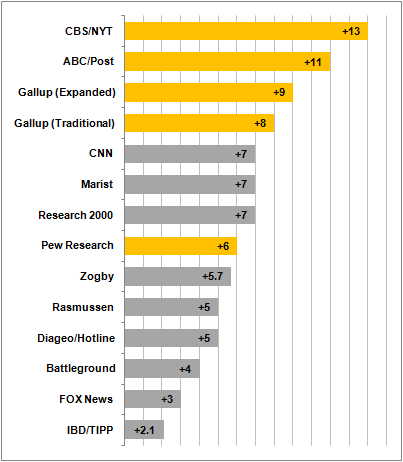
Polls can be wrong for a variety of reasons, as explained on electoral-vote.com by Andrew Tanenbaum and by me in this question. A poll samples a small collection of possible voters, and from their responses makes inferences about all voters. Any sampling process can be off for two reasons: random variation and systematic error.
Random variation: The random variation is easiest to explain, and for some reason everyone explains it by referring to a jar full of, say, blue and red jelly-beans. You shake the jar to make sure the jelly-beans are mixed up, and then reach in and grab a sample. Let's say you sample 6 red and 4 blue. Does that mean that exactly 60% of all the jelly-beans are red? Of course not; if you repeated the experiment, you might get 5 or 7 or 4 reds out of 10 the next time. By sampling only 10 individuals, you can't get a very reliable picture. But, if you sampled 1,000 jelly-beans and got, say, 54% blue, then you could be more certain that this was a good estimate. In fact, some simple math will tell you that there is a 95% chance that the actual portion of blue jelly-beans is within 3% of the sampled 54%, assuming the sample was done fairly. This 3% is the "margin of error" that is often published along with polls. The margin of error is proportional to the square root of the number of samples, so in order to cut the margin in half, we would need 4 times more samples. To cut the error by a factor of 10, we would need 100 times more samples.
Note that the term "margin of error" is misleading because some people think of it as an absolute margin, when it is actually the 95% confidence interval. When there is a 95% chance that the actual result is within 3% of the sampled 54% result, there is also a 68% chance of being within 1.5%, and a 99.993% chance of being within 6%. Sometimes you will hear innumerate reporters say "candidate X leads candidate Y by 3%, and because the margin of error is 3%, that means the race is a statistical tie." Not true. That result would mean a 95% chance that candidate X is winning. And if X was ahead by 1.5% in the poll, there would be a 68% chance that s/he was actually leading.
Why don't pollsters cut the margin of error by including more people in their sample? Mostly because it is expensive. They feel embarrassed to publish results with much fewer than 1000 samples (because the margin of error would be higher than their peers) but there is no real incentive to add more sample points. The pollster gets more publicity (and more money) from releasing 4 polls with 1000 samples each (and thus a 3% margin of error) than by releasing one poll with 4000 samples (and thus a 1.5% margin of error). But a bigger reason for not including more samples is that it would be pointless, because the systematic error would dwarf the random variation. The dirty not-so-little not-so-secret of polling is that systematic error is much harder to control, and because there is no nice clean Bernoulli formula for systematic error, the margin of error figure covers only the variation.
Systematic error: Getting back to the jelly-beans, systematic error could occur if the red jelly-beans were a slightly different size or shape than the blues, making the reds settle to the bottom of the jar. Then the sample we draw would reflect the statistics of the top of the jar, but not of the whole jar, and we would get a bad result. The "margin of error" might still be 3% (meaning that if we repeated the same flawed experiment we would get the same flawed answer (within 3%) most of the time), but the actual result could be off by 5%, 10%, or more!
Most election polls work by random digit dialing: choosing phone numbers at random (with area codes and exchanges that are known to be in the right locale). Pollsters know that this method does not give an exactly equal chance of reaching each voter: it is like a jar that is not evenly shaken. There are six main sources of systematic error that pollsters try to control for:
For some, the "celebrities" of this election are Obama, Palin, McCain and Biden. For some, it's Joe the Plumber. But for me, it is the unsung amateurs turned statisticians:

Nate Silver FiveThirtyEight | 
Sam Wang Princeton | 
John McIntyre Real Clear Politics | 
Andrew Tanenbaum Electoral vote | 
Mark Blumenthal Pollster |
|---|

Registration deadlines have passed in most if not all states, so now it is a question of where to vote. Type your address below to find out:
If you have problems voting, this article lists remedies. What about voter fraud? In the final debate, Senator McCain warned about "ACORN, who is now on the verge of maybe perpetrating one of the greatest frauds in voter history in this country, maybe destroying the fabric of democracy." Wow, that sounds serious. How big a problem is voter fraud? In 2002, the Bush administration thought it was serious indeed, and launched a crackdown. From 2002 through April 2007, this program yielded 86 convictions: 40 for vote buying/intimidation or ballot forgery, 18 for ineligible voting (e.g. by an non-citizen immigrant or a criminal on probation), 5 for voting twice, 5 for registration fraud (such as a non-citizen registering but not voting), and 2 for civil rights violations. The vote-buying schemes were all for local races; there were no convictions related to state or national races. Ronald Michaelson of the McCain-Palin Honest and Open Election Committee says he does not know of a documented case of voter fraud that resulted from a phony registration form.
Of course, where there are 86 convictions (14 per year), there may be many more crimes. For the sake of argument, let's say that for each conviction there are 100 cases of fraud that go undetected. If that were the case, fraud would amount to about 0.003% of the vote, which would not be enough to swing even the close 2000 presidential election. Fox News looked into the problem and concluded "One doesn't have to look far to find instances of fradulant ballots cast in actual elections." But readers of that article have commented that Fox did have to look pretty far: all the way back to 1984, when a study found "thousands" of fradulant votes between 1968 and 1982 in state races. Again, this comes out to somewhere in the range of 0.001% of votes. While every fradulant vote is a felony that should be taken seriously, there is no way this level of activity could affect a national race.
What was ACORN's role in this? ACORN hires workers to register people to vote, concentrating on low-income neighborhoods. This year their 13,000 workers registered 1.3 million voters. While ACORN says that "The vast, vast majority were dedicated workers," it seems clear that some of the workers find it easier to fill in false registration forms rather than do the harder work of getting real people to actually register. The workers are paid $8/hour (not paid by the form as some have reported) but if they don't hand in any forms they will soon lose their jobs, so there would be an incentive for some workers to fill out false forms. When ACORN hands the forms over to the registrar, they are separated into three piles: forms that are incomplete, those that look valid, and those that are suspect of being invalid. In most states, ACORN and others who do registration drives are required to hand over all the forms, even the suspect ones (which is a good law, because otherwise valid forms could be discarded). In most cases, the invalid forms are rejected by the state registrar. But even if a form registering Mickey Mouse is not rejected as being invalid, it is unlikely that Mickey Mouse would turn up and vote. I have not been able to come up with a single case of ACORN being involved with actual voting fraud. If you know of one, let me know. There have been several ACORN workers fired for handing in improper forms, and several have been arrested and convicted for registration fraud, not voting fraud. The situation was summed up well by supreme court justice John Paul Stevens, who wrote with respect to the case of Crawford vs. Marion County, that "the record contains no evidence of any such [voter] fraud actually occurring in Indiana at any time in its history."
On the other side of the aisle, Democrats complain about voter suppression. Robert F. Kennedy Jr. and Greg Palast claim that Republicans have eliminated millions of Democratic voters from the voter rolls. The Help America Vote Act of 2002 has a provision for removing erroneous registration records from the system. That seems like a good idea, but the problem is that most errors mean that the problem should be corrected, not that the voter should be purged. For example, "Joe the Plumber", or Samuel Joseph Wurzelbacher, is actually registered under "Worzelbacher." It seems clear he should be allowed to vote. The Republican strategy is to challenge registrations that have a typo like Joe's, forcing them to cast a provisional ballot, a process that is more time consuming and might cause frustrated voters to give up and go home rather than wait through a lengthy process. Why would Republicans use this strategy? Historically, because those who change addresses more often (and thus are more likely to have registration problems) are more likely to be low-income, and that means more likely to be Democrats. But this year especially, a large majority of new registrations are Democratic, or are young voters who tend to favor Obama. So, the NY Times reports, some states are illegally removing voters from rolls. I think this fear too is overblown. Joe the Plumber did get to vote in the primary, and I think he and other misspelled voters will vote again. TPM reports that Republican voter suppression efforts have not been successful (for a variety of reasons), and Obama counsel Bob Bauer stated "We are very confident that election officials are working to solve these problems. To the extent that the [NY Times] article left people with the impression that there is a meltdown [that will prevent people from voting], that would be the wrong belief to take away from that article."
The third problem to worry about is voting machines (of all types). In 2000, over 2 million punch-card ballots could not be read, because of either multiple or inconclusive punches. Security of voting machines has ranged from poor to incompetent. I believe that many voting machines are insecure, and should be redesigned. However, I think there are sufficient human, non-software safeguards that software fraud is not a major threat.
Despite all the claims of fraud in recent elections, there is no evidence of any fraud that makes a difference. In the 2004 election, the final total of 51% Bush to 48% Kerry closely matched the polls leading up to the election (various, but average within 1% of the final total). Sam Wong's state-by-state meta-analysis of polls predicted the final electoral vote result exactly. There was a larger discrepancy in the exit polls--everyone agrees that the exit poll totals varied significantly from the final results--but careful analysis shows that the exit polls do not conclusively show a problem (nor do they rule out the possibility of a problem). There just doesn't seem to be any clear evidence that the final vote was anything different than what the polls are telling us. Similar results hold for 2000, 2002 and 2006.
My conclusion is that voter fraud contributes less than 0.01% (probably less than 0.001%), voter suppression contributes about 0.1% (about 100,000 votes) and voting machine errors (including honest mistakes by voters) are harder to estimate but amount to less than 1%, probably less than 0.1%. Current polls predict an Obama win by about 6%, so it does not look like any of these problems will be a factor. Both parties have armies of lawyers standing by, so if there are any significant irregularities, you will certainly hear about it.
(On the other hand, you could say that the 2000 election was decided by voting error (due to the butterfly ballots), and you could equally say it was decided by Ralph Nader's ego, by Al Gore's sighs, by Jeb Bush and Katherine Harris's failure to recuse themselves, by voter suppression (by some counts nearly 3% of African Americans in Florida were removed from rolls), by the suppression of vote-pairing web sites, or by the whim of the SCOTUS.)
In December 2006, 7 US Attorneys were dismissed because they, in the eyes of the administration, did not persue voter fraud investigations vigorously enough. Perhaps they thought that other crimes were more important than a possible 0.003% of the vote (homicide, for example, is about 1000 times more common than voter fraud conviction). The dismissal of the US Attorneys was seen as an inappropriate politically-motivated move, and led to the resignation of Attorney General Gozales and 8 other officials. US Attorny David Iglesias wrote that he was dismissed because "After reviewing more than 100 complaints of voter fraud, I felt there was one possible case that should be prosecuted federally. ... I could not overcome evidentiary problems ... the FBI did not disagree with my decision ... not to prosecute."
The map below shows where states are in the process of verifying votes with an auditable paper trail. Green means verified trail and mandatory audits; golden means verified trail but no mandatory audits; yellow means no verification requirement but in practice verification is in use; red means no verification requirement. Only three of these no-verification states are considered battleground states: Pennsylvania, Virginia, and Indiana.

What do the candidates say?
You can catch soundbites from the candidates on daily newspapers, TV, or radio (I like XM radio POTUS'08, channel 130).
For longer clips, check YouChoose. Fun.
For written quotes on the topic of your choice, try In Quotes. Good for research.
You can
always go direct to the position papers from McCain and Obama. Questions
further down in this FAQ will cover specific issues.
What is this election about?
As Andrew Sullivan wrote in May 2007, Obama "is the candidate for real change. He has what Reagan had in 1980 and Clinton had in 1992: the wind at his back. Sometimes, elections really do come down to a simple choice: change or more of the same?" It seems everyone now agrees with the message of change (see video at right). With the current president's approval rating at around 25%, and in the latest poll only 13% believing the country is headed in the right direction, it is clear voters want something different. That's why Obama, who adopted the message of "Change" from the start, was able to win the nomination over Clinton, who focused on the message of "Experience." Ordinarily this sentiment would mean the incumbent party was in for a big loss.
But McCain also chose the message of "Change" (and "Maverick"), allowing him to beat out the Republican field. As McCain put it in a Sept. 4th speech: "I fight to restore the pride and principles of our party. We were elected to change Washington, and we let Washington change us. We lost -- we lost the trust of the American people when some Republicans gave in to the temptations of corruption. We lost their trust when rather than reform government, both parties made it bigger. We lost their trust when instead of freeing ourselves from a dangerous dependence on foreign oil, both parties -- and Sen. Obama -- passed another corporate welfare bill for oil companies. We lost their trust when we valued our power over our principles. We're going to change that. We're going to recover the people's trust by standing up again to the values Americans admire. The party of Lincoln, Roosevelt and Reagan is going to get back to basics."
In a NY Times/CBS poll on Sept. 18, 65% thought Obama would bring real change; only 37% thought that of McCain.
It's the economy, stupid.
In terms of issues, the latest poll lists these as the most important issues in electing the next president:
| The economy and jobs | 57% | See link below |
| Terrorism and national security | 9% | See link below |
| Health care | 8% | |
| Gas prices and energy policy | 7% | |
| The war in Iraq | 7% |
Who has the better economic plan? Voters prefer Obama by a large margin (46% to 29% in an Oct. 5th poll). And roughly 60% of voters think the economy is the most important issue. On the other hand, the average voter has not thoroughly researched the two candidates' plans, so poll results may be based on superficial reactions, or on a backlash against the Bush policies.
The Economist, the fiscally-conservative socially-liberal London-based weekly news magazine, canvassed 142 American economists. 80% thought Obama had the better plan. If you discard the respondents who identified as either Republic or Democrat, 71% of the independents favored Obama. Similar numbers hold for the question of who understands the economy better; even among self-identified Republicans, twice as many thought Obama had a better understanding of economics. Both The Economist and the centrist Financial Times endorsed Obama; the other financial publication of record, the conservative Wall Street Journal, has not made a presidential endorsement in 70 years (they chose Herbert Hoover then) but may make a pick this year.
Advisors: Of course, a president picks advisors to help with tough economic problems; 81% of respondents (and 71% of independent respondents) thought Obama would assemble the superior team of advisors. On McCain's side, there was widespread bipartisan support saying that Doug Holtz-Eakin, McCain's main economic advisor, would do a good job, but there was widespread skepticism of Phil Gramm, another McCain advisor, who said the problem today is that we are a nation of whiners, and co-sponsored the Commodity Futures Modernization Act of 2000, which legalized credit default swaps, which were in part responsible for the current economic crisis. Part of McCain's perceived problem is that he, like Gramm, has a long record of support for deregulation and said on Sept. 20th "I think the deregulation was probably helpful to the growth of our economy." Obama's team was seen as "mainstream and non-ideological but extremely talented." His top advisors are Austan Goolsbee and Jeffrey Liebman.
McCain got his best advantage on the subject of free trade and globalization. (I agree; I thought McCain's spokesman's statement that "John McCain cannot support farm policies that are too costly for the taxpayer, particularly when they also play a negative role in encouraging farmers to rely on government subsidies" was exactly the right policy, and courageous in that neither party had taken on farm subsidies in this way.)

 Elsewhere, the Economists
for Obama blog claims that economists support Obama by a 2-1
margin. On Oct. 21st, Federal Reserve Chairman Ben Bernake endorsed
Obama's stimulus plan. For his part, McCain has a list titled 100
economists who favor McCain, but actually it contains 90 names,
most notably Burton Malkiel and George Shultz. The USA Today chart at right of contributions
from various business sectors shows that business people are more comfortable with Obama than McCain. This may reflect their business policies, or it may just mean people go with the leader.
Elsewhere, the Economists
for Obama blog claims that economists support Obama by a 2-1
margin. On Oct. 21st, Federal Reserve Chairman Ben Bernake endorsed
Obama's stimulus plan. For his part, McCain has a list titled 100
economists who favor McCain, but actually it contains 90 names,
most notably Burton Malkiel and George Shultz. The USA Today chart at right of contributions
from various business sectors shows that business people are more comfortable with Obama than McCain. This may reflect their business policies, or it may just mean people go with the leader.
Bailout warning: In the second presidential debate, both candidates said they had written a letter warning of the crisis. McCain's May 5, 2006 letter to Frist and Banking Committee Chairman Richard Shelby is here. It warns that "if effective regulatory reform legislation ... is not enacted this year, American taxpayers will continue to be exposed to the enormous risk that Fannie Mae and Freddie Mac pose." Obama's March 22, 2007 letter to Bernake and Paulson is here. It expresses concern over "a potential coming wave of foreclosures" and suggests that "Working together, the relevant private sector entities and regulators may be best positioned for quick and targeted responses to mitigate the danger." They were both right. But then Nobel-winning economist Paul Krugman predicted the meltdown in 2005.
Temperament and economic education: McCain has said The issue of economics is something that I've really never understood as well as I should." It also appears he is not interested in learning about the complexities; preferring an over-simplified view. George Will relates a story where "A Republican financial expert recalls attending a dinner with McCain for the purpose of discussing with him domestic and international financial complexities that clearly did not fascinate the senator. As the dinner ended, McCain's question for his briefer was `So, who's the villain?' " Obama, on the other hand, seems to be willing to deal with complexity and nuance, and not search for a single villain.
McCain's recently is using a good line that resonates with many (including me): "We both disagree with President Bush on economic policy. The difference is that he thinks taxes have been too low, and I think that spending has been too high." I agree that the biggest problem with Bush's economic policy has been out-of-control spending. But the problems with McCain's line are (1) now, in a time of financial crisis, most experts agree that the government should spend to create a stimulus, (2) spending wasn't the only problem with Bush's policy: deregulation was one of the many causes of the financial crisis, and McCain has been a staunch supporter of deregulation, (3) Obama's plan lets Bush's temporary tax cuts expire; McCain himself was against Bush's tax cuts when they were proposed, saying "when you ... reach a certain level of comfort, there's nothing wrong with paying somewhat more", (4) while it is true that Obama wants to raise total government revenues by restoring a higher tax rate for the richest, for most American's it is Obama's plan, not McCain's, that will cut their taxes, and (5) of all the states that spread someone else's wealth around, it is Palin's state, Alaska, that does it the most. McCain has also been criticizing Obama for wanting to "spread the wealth around", but Obama points out that what he is doing is similar to what McCain's heroes have done: Teddy Roosevelt instituted the progressive income tax, and Ronald Reagan initiated the earned income credit, for example. But the biggest problem or McCain is that Americans like the idea of spreading the wealth around. By a 58%-37% margin, they think wealth should be more evenly distributed. McCain has made progress: earlier this year it was a 68%-27% margin; but he is still in the minority.

Taxes: For average citizens, one of the most important economic topics is tax policy. Both candidates want to reduce taxes. According to an analysis by the Tax Policy Center, McCain's tax cuts would result in a reduction of tax revenues of $3.6 trillion (10%) over the next ten years, and Obama's in a reduction of $2.7 trillion (7%). Both candidates give tax cuts to every family making less than $200,000/year. Obama's plan gives tax increases to those making over $600,000/year (the top 1%), while McCain gives the largest cuts to the top 1%. If your family income is less than $100,000/year, you'll get a much bigger cut from Obama, if you make $100,000 to $160,000 you'll get a little more from McCain, and if you make over $160,000 you'll do a lot better with McCain.
According to the Tax Policy Center, Obama's plan would increase the national debt by $3.5 trillion (or $12,000 per American) over 10 years. McCain's plan would increase the national debt by $5 trillion (or $17,000 per American). See their pdf report.

According to the Committee for a Responsible Federal Budget, here's how the candidates's tax and spending plans would affect the deficit in the year 2013 (full report here). A negative number increases the deficit, a positive number decreases the deficit:
|
|
In other words, McCain will cut taxes more and will also cut spending more. The net result is that both will increase the deficit (spend more than they take in), but McCain will do it less, by $20 to $112 billion. But take these estimates with a grain of salt--for example, McCain's number includes a savings of $159 billion for "unspecified cuts to balance the budget." If it turns out he can't specify all $159 billion, it might turn out that Obama's plan in the more fiscally responsible.
Joe the plumber: It turns out Joe would get a tax cut under
Obama's plan. But what if he did end up making more than $250,000 a
year? Then he would pay more taxes, but he would get more help from
Obama for paying for health care for his employees. Adam Smith, the
founder of capitalism (and of economics) said "It is not very
unreasonable that the rich should contribute to the public expense,
not only in proportion to their revenue, but something more than in
that proportion." Billionaire Warren Buffet complains that his taxes
are too low: he paid 18% in taxes, and his secretary and other office
staff members averaged 33%. He thinks he should pay more. Obama
agrees; McCain thinks the rich should pay less.
What about the terrorism and national security?
In 2004, Bush won reelection by convincing voters that he could better
keep the country safe from terrorists. This year the country's
perceived threats have changed. The world is still a dangerous and
uncertain place, but there are different priorities. Here are some of
the top issues, and how the candidates would handle them.
Iran: McCain has criticized Obama for being willing to enter into talks with Iran before they make concessions. Various secretaries of state have supported Obama's view. McCain says "there's only one thing worse than military action against Iran and that is a nuclear-armed Iran." Obama said he "would only use force as a last resort." I think that Obama would successfully use pressure to end Iran's nuclear program and that McCain would lead us into war with Iran, which would go about as well as war with Iraq.
Pakistan: McCain has criticized Obama for suggesting that the US should follow Taliban and al-Qaeda fighters that flee from Afghanistan into Pakistan, and attack them in Pakistan, calling the idea "naive." Obama's idea is now the policy of US forces in Afghanistan, as planned by the Joint Chiefs of Staff and approved by Bush. The jury is still out as to whether it was a good idea, but it appears that Pakistan has tacitly agreed with the policy. If Obama is naive, then the Joint Chiefs of Staff are naive. McCain has been a moderate with respect to Pakistan.
Military: Both would cut certain (vaguely specified) combat systems. Obama wants to cut "unproven missle defense" and "future combat systems;" McCain would cut the Boeing C-17 and YAL-1 and the "future combat systems." Both recognize that times have changed, and our enemies will be more insurgents, less big armies and navies. Obama would add 90,000 soldiers; McCain also supports a large military.
Torture: Both candidates would offer marked change from the current administration. Both think waterboarding is torture, torture is wrong, Guantanamo should be closed, and the prisoners there should be tried. McCain negotiated a compromise bill that got some of what he wanted, but allowed Bush to make interpretations on what counts as torture. McCain was criticized for the compromise on torture and nhabeus corpus, but I think McCain would favor a no-compromise stand if elected. I know Obama would.
Nonproliferation: This was one of Obama's priorities in the Senate (working with Sen. Luger); he would "crack down on nuclear proliferation," styop the development of new US nuclear weapons, and work to eliminate nuclear weapons in the future. McCain thinks the US should reduce nuclear weapons to encourage other nations to follow.
Rule of Law: One of the main factors driving Bush's approval
rating to a record low is his theory of the unified executive: a
president (and vice president) who are above the
constitutional and the rule of law. Bush claimed the power to
seize any person, US citizen or not, anywhere in the world, and
declare him an enemy combatant, and detain (and torture) him forever
without due process. This squandered the US's moral authority and
brought us down to the level of the terrorists we were fighting. Of
all the tasks facing the next president, the task of restoring the
rule of law, the constitution, and America's standing in the world is
the most important. McCain would be a big imporvement over Bush. But
he has compromised over basic rights like habeous corpus, and
he has indicated that he likes supreme court judges who would grant
the President unchecked power. Obama would not allow the supreme
court to go down that path, has never wavered in his support of the
constitution, and is already winning the referendum in the eyes of the
world -- he is the overwhelming choice of both the public and foreign
leaders in countries around the world. If the constitution is
important to you, Obama is a better choice.
How do voters feel about the issues?
Here is an interesting
article on 22 issues. I wouldn't have put Cuba and the
Everglades on my list of top 22 issues, but this was in a Florida
paper. Overall, the plurality of the American public:
In this election, all four contenders are senators or governors and thus are feasible candidates for the job; they can't be rejected for their resume alone. Obama may be on the low side for experience by a presidential candidate (with 8 years IL senate and 4 years US senate), but so were Abraham Lincoln (8 years IL house and 2 years US house), Ronald Reagan (8 years CA governor), and John F. Kennedy (6 years MA house, 7 years US senate), the three top-rated presidents of all time, according to this Gallup poll. Palin (2 years AK governor) may be near the bottom for experience by a VP candidate (only Spiro Agnew (2 years MD governor) and Chester Arthur (7 years NY port collector) had so little experience according to Lessig), but experience alone cannot predict how any candidate might do on the job. Another Damn Blog does a statistical analysis to show that a president's success (as measured by historian's rankings) is not correlated with age nor with legislative experience.
So let's look past the resumes and evaluate the pros and cons of
each candidate.
What are the pros and cons for McCain?
Pros: Many years of experience, served in the military and as a
POW, has a long record of bipartisan efforts in the Senate, and has
the appeal of tax cuts for both citizens and businesses. Deserves
credit for going against his fellow Republicans with some tough stands
against ethanol subsidies, federal hurricane insurance, ANWR drilling
and pork spending. Strongest Republican on global warming. Was a
chief proponent of the surge in Iraq, where conditions are much
improved.
Cons: McCain faces two main challenges. First, some may disagree with parts of his record. On Iraq, he was a hawk, stating that Saddam certainly had WMDs, the war would be fast, easy, and with few casualties, and that we would be welcomed as liberators. On the economy, he has a history of deregulation of financial markets, the stain of the Keating Five scandal, campaign manager Rick Davis's lobbying money from Fannie Mae an Freddie Mac, and his seeming out of touch by not being able to remember how many houses he has and saying "the fundamentals of the economy are strong" the day before the biggest collapse in 70 years.
Second, some have criticized his temperament. He has an advantage over Obama in experience, but is McCain too angry? Or too quick to make a decision from the gut, rather than waiting to analyze it? Too much like George W. Bush? Again, we'll ignore partisan critics from the other side. But serious arch-conservatives such as George F. Will have expressed concern that "Under the pressure of the financial crisis, one presidential candidate is behaving like a flustered rookie playing in a league too high. ... It is not Barack Obama." and "the more one sees of [McCain's] impulsive, intensely personal reactions to people and events, the less confidence one has that he would select judges by calm reflection and clear principles, having neither patience nor aptitude for either." and concludes "It is arguable that, because of his inexperience, Obama is not ready for the presidency. It is arguable that McCain, because of his boiling moralism and bottomless reservoir of certitudes, is not suited to the presidency. Unreadiness can be corrected, although perhaps at great cost, by experience. Can a dismaying temperament be fixed?" Similarly, Elizabeth Drew, who wrote the very positive biography Citizen McCain, now believes that McCain has thrown away his reputation, that "there was a disturbingly erratic side of McCain's nature. There's a certain lack of seriousness in him. And he does not appear to be a reflective man, or very interested in domestic issues. One cannot imagine him ruminating late into the night about, say, how to educate and train Americans for the new global and technological challenges."
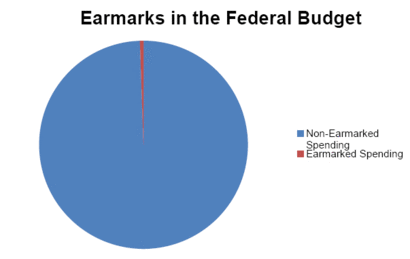
If the "McCain is not serious" criticism sticks, his chances disappear. It does seem that he has an annoying tendency to fixate on small parts of the problem, parts that he believes can have a strong emotional impact. For example, McCain emphasizes new offshore drilling, which if started now could make up about 1% of our oil needs in 20 years (yellow wedge below). He emphasizes eliminating earmarks, which is a laudable goal; it would be great if we could get rid of them. But earmarks make up about 1/2 of 1% of the budget (orange slice below); in a time of economic crisis such as today, it seems silly to concentrate on less than 1% of the problem (especially when McCain voted for the bailout package, which contained about $100 billion of earmarks; more than McCain could eliminate even if he got rid of 100% of earmarks each year for 8 years in office).
 |  |

Cons: Here are Obama's two main challenges. First he has been portrayed as too inexperienced--only 47 years old, with just 8 years in the Illinois state senate and 4 years in the US senate. He needs to show that he has what it takes to lead the country. Polls taken after the first debate show that he is closing the gap, but McCain still leads on experience. The neocon computer scientist David Gelernter makes the case that Obama himself as well as his whole post-cultural-revolution generation is incapable of facing up to the brutalities of the real world. Gelernter's essay is short on facts and argument, but it expresses perfectly the rage and contempt he feels for youngsters like Obama. If McCain shares this contempt, that would explain why McCain refused to look Obama in the eye during the first debate: Gelernter (and perhaps McCain) doesn't see Obama as an accomplished US Senator, but rather a foolish child. That would explain why McCain could pick Palin as VP: any risk is worth it if the alternative is that McCain the adult is denied the Whitehouse in favor of a foolish and dangerous child.
Second, Obama has been criticized as being a liberal bent on higher taxes and bigger government. The National Taxpayers Union says Obama would increase spending by $292 billion annually, while McCain would increase spending by only $92 billion (I still can't get used to putting "only" before $92 billion). But Obama is more fiscally responsible, in that his higher taxes on the rich mean he comes $1.5 trillion closer to balancing the budget than does McCain (over a ten year period). See the question in this FAQ on the economy.
What are the pros and cons of Biden?
Pros: Very experienced; as chairman of Senate Foreign Relations Committee, shores up Obama's weakness.
Cons: Loose cannon; "a persistent tendency to say silly, offensive, and off-putting things." His long tenure in Washington undercuts Obama's message of change.
But let's face it: Biden's presence in this race is not going to be
a deciding factor.
What are the pros and cons of Palin?
Pros: Young and dynamic; compelling personal story; attractive to evangelical Christian voters and potentially to women voters. (Immediately after selecting Palin, McCain received a 53% to 37% lead among white women voters. But as of Sept. 24, the lead had swung back to Obama, 48% to 42%, about the same as voters in general.)
Cons: Several ongoing scandals (especially Troopergate) and cover-ups of scandals. More importantly, the perception that she is just not a viable candidate. (51% thought she was unqualified in a September 27-29 Pew poll, 60% in a Washington Post/ABC poll the same dates, and 75% in a NY Times/CBS poll though she was picked to win the election, not because she was qualified.) Ignore the partisan liberal detractors; what they say is just noise. But it is significant that a number of top conservative thinkers, including many who initially applauded Palin, now feel she is not qualified:

Talking Points Memo made the following graphic of Palin reaction quotes; hover over a person or newspaper to see their reaction.

Palin's performance in the vice-presidential debate seemed to have had two effects. First, it silenced the critics who, based mostly on the Couric interviews, worried that Palin could not even form a coherent English sentence. Second, for a majority of viewers it reinforced the view that Biden is the more experienced, knowledgeable pick. Here is a survey of polling results on who won the vice-presidential debate:
| Polling Agency | Biden | Palin | Differential |
|---|---|---|---|
| CNN/Opinion Research | 51 | 36 | Biden +15 |
| CBS | 46 | 21 | Biden +25 |
| Fox | 61 | 39 | Biden +22 |
| Survey USA | 51 | 32 | Biden +19 |
| MediaCurves | 67 | 33 | Biden +34 |
| Average | 55 | 32 | Biden +23 |
Now is the season: you can see Wikipedia's list of newspaper endorsements and an interactive map of the paper's locations. As of Nov. 3rd, Obama has 458 (including 62 papers that endorsed Bush in 2004) and McCain has 171 (with 9 that endorsed Kerry in 2004). In other words, Obama has 73% of the endorsements, including 27% of the papers that favored Bush and 98% of the ones that endorsed Kerry.
You can also see a long list of individual endorsements for both McCain and Obama.
In general, Republicans endorse McCain and Democrats endorse Obama. Are you shocked? McCain gets the tough guy actors (James Caan, Robert Duvall, Clint Eastwood, Sylvester Stallone, Jon Voight). Obama gets the hip and/or young actors (Ben Affleck, Halle Berry, Pierce Brosnan, John Cleese, George Clooney, Gena Davis, Morgan Freeman, Tom Hanks, Samuel L. Jackson, Brad Pitt, Ben Stiller, Will Ferrell). Obama also gets some surprises, like NASCAR champion Junior Johnson.
But beyond the celebrity gossip, I found three interesting things. I wasn't surprised that McCain has "over 100 generals and admirals" in his camp (although only 26 military people, not all generals or admirals, are actually listed on the Wikipedia page) as well as organizations such as Vets for Freedom. But I was surprised to see that Obama also does well with military endorsements: he has 22 top military endorsers, including Colin Powell, and several veterans groups: Vet Pac, VoteVets.org, and the AFL-CIO Union Veterans Council.
Second, Obama has a list of 76 Nobel Laureate scientists, including many of my favorites: Harold Varmus, Don Glaser, Eric Kandel, Leon Lederman, Craig Mello, and Burton Richter. Obama also has six Nobel economists, and 11 economists overall. McCain has one economist, Anne Kreuger. The words "Nobel" and "Scientist" do not appear on McCain's page.
Third, Obama has the endorsement of 13
foreign political leaders. The only
foreign endorsement for McCain is Norm McDonald, the former
Saturday Night Live comedian. He's Canadian.
Who can best reach across the aisle?
In a period where Americans seem to be looking for better bipartisan
cooperation, both candidates have something to offer. The American
Conservative Union's list of 5
best and 21 worst senators does not mention either McCain or
Obama, so they're both somewhat moderate.
McCain is well-known for co-sponsoring legislation with Democrats, such as the McCain-Feingold campaign reform act. He worked with Ted Kennedy on immigration reform, and Joe Lieberman on cap-and-trade for greenhouse gases, but could not get either law past Republican opposition.
Obama has also had bipartisan success (or post-partisan, as he calls it), working with Republicans on the Lugar-Obama act on nuclear nonproliferation and the Coburn-Obama act which introduced USAspending.org, a web site detailing government spending.
McCain enjoys the support of several prominent Democrats, most notably Joe Lieberman, but also NH house member Doreen Howard and Lady Lynn Forester de Rothschild, a former Hilary Clinton fundraiser.
Obama enjoys the
support of Republican politicians Colin Powell, Bill Weld,
Larry Pressler, Arne Carlson, Lincoln Chafee, Pete McCloskey, Wayne
Gilchrest, John B. Anderson, Jim Leach, Paul O'Neill, and Lowell
Weicker, as well as first (grand)daughters Julie Nixon Eisenhower
and Susan Eisenhower, candidate-first-granddaughter C.C. Goldwater,
prominent scholar Francis Fukiyama, commentator Andrew Sullivan,
Bush aides Ken Adelman and Scott McClellan, McCain aide Charles
Fried, William F. Buckley's son Christopher (who was fired from
National Review over his endorsement), and athlete Charles
Barkley (Sir Charles never actually held office, but he did hold
court).
Are the candidates always honest?
No.
How honest or dishonest are they?
Probably the best referee in this game is Factcheck.org, from UPenn's Annenberg Political Policy Center, a nonpartisan nonprofit consumer advocate for voters. They don't give out easily classified scores so I can't summarize briefly, but you can read a comrehensive article from Sept. 25 listing the major whoppers so far.
Other players in this game include CNN's Fact Check and the St. Petersburg (FL) Times, an independent non-profit paper, which runs PolitiFact. They too check on candidates statements and rate them on a scale from "True" to "Liar, Liar, Pants on Fire." Here is the scorecard through Oct. 21. My column "True Pct" means the percentage of statements that were rated True, Mostly True, or Half True; "Lie Pct" means the percentage that were False or Pants on Fire:
| Candidate | True | Mostly True | Half True | Barely True | False | Pants on Fire | True Pct | Lie Pct | Average Score |
| Obama | 49 | 28 | 30 | 17 | 25 | 2 | 71% | 18% | Mostly True |
| McCain | 29 | 27 | 26 | 27 | 30 | 7 | 56% | 25% | Half True |
Here's the list of statements that were rated as Pants On Fire:
Overall, it looks like if Diogenes met either campaign on the street, he would pass on by. Of course, dishonesty in presidential elections is nothing new. In the 1800 election, according to Wikipedia, "Federalists spread rumors that the Democratic-Republicans were radicals who would murder their opponents, burn churches, and destroy the country." In 2008, campaign officials and partisans of both sides accuse the other of dishonesty. But when you discard those partisans and consider only independent analysts, or commenters who frankly criticize their own side, you find that McCain has gone much farther than Obama. Even Karl Rove, the architect of the modern renaissance in dishonest politics, said "McCain has gone too far in some of his ads." AP writer Charles Babbington wrote on Sept. 11 that "Even in a political culture accustomed to truth-stretching, McCain's skirting of facts has stood out this week." Conservative NY Times columnist and avid McCain fan David Brooks wrote "Do I wish he was running a different campaign? Yes. It's not ... the dishonest ads he is running. ... No, what disappoints me about the McCain campaign is it has no central argument." but concludes "If McCain is elected, he will retain his instinct for the hard challenge. With that Greatest Generation style of his, he will run the least partisan administration in recent times. He is not a sophisticated conceptual thinker, but he is a good judge of character. He is not an organized administrator, but he has become a practiced legislative craftsman. He is, above all ... a serious man prone to serious things." Washington Post columnist Ruth Marcus wrote on Sept. 17 that "John McCain's campaign has been more dishonest, more unfair, more ... dishonorable than Barack Obama's." But then she wrote on Sept. 22 that Obama was "closing the whopper gap."
How honest are the vice presidential candidates? I think it makes
less sense to concentrate on this, since really what matters is each
campaign's message, not who delivers it.
Still, the VP hopefuls have had their share of
problems. Conservative blogger/columnist Andrew Sullivan chronicles
Palin's provably untrue statements. The New Republic keeps a Gaffe-O-Meter
for Biden.
What do special interest groups think?
About what you'd expect: conservative groups like McCain, liberal
groups like Obama.
One surprise: more veterans groups like Obama better. It seems that when it comes to issues of veteran care, McCain prefers to cut government spending and Obama prefers to support the veterans even if it means increased spending.
Caveat: they're called special interest groups. That's because they have special interests. Don't assume that a group represents your interests because it has the word Family in its title and you belong to a family, or because it has the word Retired and you're retired. Be sure to check out each group. But with those caveats, it looks like:
McCain does better with conservative, anti-abortion, and guns groups.
Obama does better with liberal, veterans, pro-abortion-choice, civil rights, education, energy, environment, health, and labor groups.
| McCain | Obama | Year | |||||||||||||||||||||||||||||||||||||||||||||||||||||||||||||||||||||||||||||||||||||||||||||||||||||||||||||||||||||||||||||||||||||||||||||||||||||||||||||||||||||||||||||||||||||||||||||
|---|---|---|---|---|---|---|---|---|---|---|---|---|---|---|---|---|---|---|---|---|---|---|---|---|---|---|---|---|---|---|---|---|---|---|---|---|---|---|---|---|---|---|---|---|---|---|---|---|---|---|---|---|---|---|---|---|---|---|---|---|---|---|---|---|---|---|---|---|---|---|---|---|---|---|---|---|---|---|---|---|---|---|---|---|---|---|---|---|---|---|---|---|---|---|---|---|---|---|---|---|---|---|---|---|---|---|---|---|---|---|---|---|---|---|---|---|---|---|---|---|---|---|---|---|---|---|---|---|---|---|---|---|---|---|---|---|---|---|---|---|---|---|---|---|---|---|---|---|---|---|---|---|---|---|---|---|---|---|---|---|---|---|---|---|---|---|---|---|---|---|---|---|---|---|---|---|---|---|---|---|---|---|---|---|---|---|---|---|---|---|---|
Conservative/Liberal:
| American
Conservative Union | 82 | 8 | 2007
| Americans for Democratic
Action (Liberal group) | 10 | 75 | 2007
| National Journal - Liberal on Economic Policy | 35 | 87 | 2007
| National Journal - Liberal on Foreign Policy | 40 | 85 | 2007
| National Journal - Liberal on Social
Policy | 53 | 77 | 2007
| Veterans:
| Disabled
American Veterans | 20 | 80 | 2006
| Iraq and Afghanistan Veterans of America
| D | B+ | 2006
| Abortion:
| NARAL Pro-Choice America | 0 | 100 | 2007
| National Right to Life Committee | 75 | 0 | 2007
| Taxes:
| Americans for Tax Reform | 80 | 15 | 2006
| Citizens for Tax Justice | 50 | 100 | 2005-2006
| Civil Rights:
| American Civil Liberties Union | 50 | 80 | 2007
| Human Rights Campaign | 33 | 89 | 2005-2006
| NAACP | 7 | 100 | 2005-2006
| League of Women Voters | 17 | 100 | 2007
| Education:
| American Association of University Women | 0 | 66 | 2007
| National Education Association | F | A | 2007
| Energy:
| Campaign for America's Future (Energy
Policy) | 17 | 100 | 2005-2006
| Environment:
| League of Conservation
Voters | 0 | 67 | 2007
| League of Conservation Voters
| 26 | 96 | Lifetime
| Environment America | 0 | 90 | 2008
| American Wilderness Coalition | 16 | 100 | 2006
| Family:
| Children's Defense Fund | 10 | 70 | 2007
| Family Research Council (Tony Perkins) | 42 | 0 | 2007
| International:
| Citizens for Global Solutions | F | A | 2008
| The Genocide Intervention Network--Darfur Scores | C | A | 2007
| Center for Security Policy | 59 | 21 | 2005-2006
| Government Reform:
| U.S. Public Interest Research Group | 41 | 86 | 2006
| Citizens Against Government Waste | 91 | 13 | 2005-2006
| Guns:
| National Rifle Association
| C+ | F | Lifetime to 2004
| Health:
| American Academy of Family Physicians | 0 | 100 | 2007
| Labor:
| AFL-CIO | 0 | 100 | 2007
| United Auto Workers | 0 | 62 | 2007
| Alliance for Retired Americans | 0 | 100 | 2007
| | ||||||||||||||||||||||||||||||||||||||||||
|
It could happen. (There was a tie in 1800.) Nate Silver's simulations
at 538 give
about a 1%
chance of a tie this time. At the right is just one scenario that results in a 269-269
tie (click on it to create your own).
The 12th amendment dictates that the incoming congress then gets to choose, but the exact rules are complex. The Senate chooses the vice-president; one senator one vote. Currently the prediction is for some 54 to 57 Democratic senators, so this scenario welcomes Joe Biden as VP. Meanwhile, the House of Representatives chooses the president. But here it is one state one vote. The 53 Californian representatives get together to make their choice, and the 1 North Dakotan representative has an equal vote. Currently the Democrats control 26 states to 21 for the Republicans, with 3 ties. It is more likely that the Democrats will hold or add to that lead in the election, and the House would then select Obama as president. But it is possible that the Republicans (although they have no credible chance of taking a lead in the total number of representatives) could take the lead in the number of states, and Biden could find himself working with president McCain. Or maybe neither party would be able to muster a majority of votes in the House. If the Senate chooses Biden and the House is split, Biden becomes president. If neither chamber is able to make a choice, then speaker of the House Nancy Pelosi becomes president. | 
|
I have been criticized for not paying more attention to third party candidates. In leaving them out, I am not making any comment on their suitability to be president. Rather, I am acknowledging the fact that their probability of becoming president is near-zero.
A vote for president does two things: first, it has a chance of
actually making the difference that gives one candidate a win.
Second, it records a tally, regardless of the winner. A vote for a
third party candidate has no effect on the first issue (which is what
this FAQ is about) but does have an effect on the second. In fact, I
have exercised this option in the past, voting for a third party as a
protest, because I wanted to record the fact that I was not satisfied
with the two-party choices (also, the winner of my state's electoral
votes was never in doubt). If you want to know your options for
recording a protest vote, you'll need a different FAQ.
Is the media biased?
The media could be biased in two ways: by giving more coverage
to one candidate, or by giving more positive coverage to one
candidate. We'll consider both.
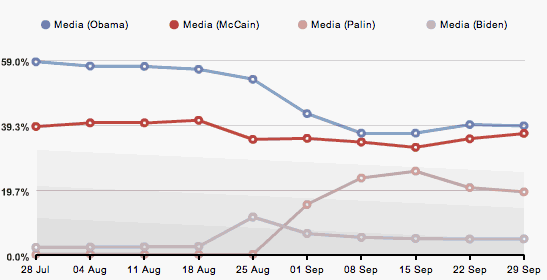
Amount of media coverage: According to Scharl and Weichselbraun's Election 2008 Web Monitor, Obama has consistently gotten more press coverage than McCain, although the gap has narrowed the last three weeks to about 2% (see chart below). When we count total coverage (Obama + Biden vs. McCain + Palin), the Republicans have the edge by about 15%, ever since the selection of Palin. You could argue that the media was biased towards Obama, and then switched to be biased towards Palin. But it seems more likely that the media is biased towards writing more about someone new. (Guess that's why they call it the news.)
 Amount of press attention |
|---|
We can double-check the figures with another source: Google Trends. The data (see chart below) says that Obama gets more coverage than McCain throughout 2008, both in news articles (bottom) and in number of searches (top), but Palin beat everyone for number of searches in August and September. The news volume from Google Trends closely matches the volume from the Scharl and Weishselbraun graph. It is also true that the news and search volumes are very closely correlated. Of course, anytime you have two variables, there are three ways they can be connected. It could be that searchers react to the news, so when the press writes more stories about a topic, people search for it. The problem with that theory is that the spikes of interest in Palin and Obama at the time of the conventions occur earlier for searches than for news. The second possibility is that reporters react to user's interests; under that theory, reporters are matching demand well; they're not biased, they're just turning out the product that consumers want. The third interpretation is that events in the world cause both searches and news articles to occur. For events like A (Obama clinches nomination) and E (Obama, McCain debate), that effect seems clear.

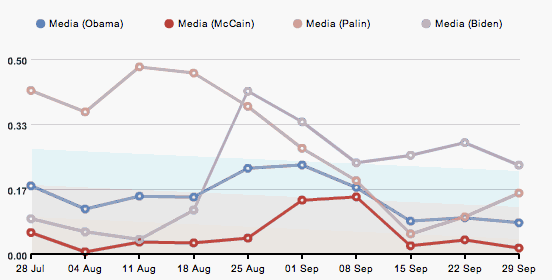
Sentiment of media coverage: Now for the hard part. It was easy to measure the volume of coverage for each candidate, but it is much harder to measure the sentiment--whether reporters are writing good things or bad. Scharl and Weichselbraun try to estimate this by counting positive and negative words that appear near a candidate's name. They find that more positive words have been associated with Obama than with McCain, although the most positive reporting of all was for Palin in July and August, and the most positive as of the end of September was for Biden (see chart below). Is this biased? The Philadelphia Phillies got more positive press coverage this fall than the New York Mets, but that isn't because of media bias--it's because the Phillies won the World Series while the Mets had another late-season collapse. Baseball gives us a good way to measure objective results (games won and lost) but politics does not, so it is hard to tell whether positive/negative coverage is deserved or not.
 Positive sentiment in articles |
|---|
We can double-check the sentiment figures by looking at another study. Robert Lichter found that during the primary elections, Obama was favored by the press with 62% positive statements, compared to 34% for McCain. But from the end of the primaries up through July, the press favored McCain, who received 43% positive coverage, compared to just 28% for Obama. From August 23 to September 25th, Lichter found that Palin had the most coverage (77 stories for Palin compared to 71 for McCain and 39 for Obama) and the most positive coverage (67% positive for Palin, 56% for Obama, 40% for McCain). Lichter's results are interesting, particularly the ones that refute the conventional wisdom that the media prefers Obama. Unfortunately, his study looked at a rather small number of stories, and it can only tell you how positive/negative coverage is; it can't tell you how positive/negative it should be.
A clever study by Tim Groeling figures a way around this. He zeroed in on one class of objective event: the coverage of approval polls for presidents Clinton and Bush, from 1997 to 2008. Sometimes these polls go up, sometimes they go down. Sometimes a news outlet does a story on a poll, sometimes it doesn't. If a news outlet did a story most of the time when Clinton's polls were going up and when Bush's polls were going down, but not vice-versa, then we could say the outlet had a Democratic predilection (Groeling prefers the word "predilection" to "bias"). Groeling found that CBS, NBC and ABC had a Democratic predilection and that FOX News had a Republican predilection. A study by the Project for Excellence in Journalism found that: MSNBC was the most negative towards McCain; Fox was equally negative towards McCain and Obama; CNN was the only network to have more negative than positive for both candidates; and that Obama did better (and McCain worse) in newspapers than on TV.
Another clever approach to objectively studying bias was described by economists Matthew Gentzkow and Jesse Shapiro. They counted the most partisan phrases in the 2005 Congressional Record---the phrases used most by one party and not the other. For example, they found "death tax" was a Republican term, used by them 365 times, and only 35 times by Democrats. The alternative, "estate tax" was used by Democrats 195 times, but only 46 times by Republicans. They then studied how often terms like these were used by newspapers. Sure enough, the liberal Washington Post used "estate tax" five times more often than the conservative Washington Times. That was a good way to decide the leanings of newspapers; their next step was to hypothesize why papers lean one way or another. Was it the liberal bias of reporters? Was it the conservative bias of big-corporate owners? It turns out that there was a simple economic explanation (the authors were economists after all). Shapiro explained "The data suggest that newspapers are targeting their political slant to their customer's demand and choosing the amount of slant that will maximize their sales." That is, newspapers with liberal customers publish a liberal-leaning paper, while papers with conservative customers lean conservative. (Economist and current Obama advisor Austan Goolsbee has a 2006 article on this finding.)
Let me explain what the question means. For your vote to have an effect on the outcome of the election, you would have to live in a decisive state, meaning a state that would give one candidate or the other the required 270th electoral vote. More importantly, your vote would have to break an exact tie in your state. With 100 million voters nationwide, what are the chances of that? If the chance is so small, why bother voting at all?
Historically, most voters either didn't worry about this problem, or figured they would vote despite the fact that they weren't likely to change the outcome, or vote because they want to register the degree of support for their candidate (even a vote tht is not decisive is a vote that helps establish whether or not the winner has a "mandate"). But then the 2000 Florida election changed all that, with its slim 537 vote (0.009%) margin.
What is the probability that there will be a decisive state with a very close vote total? Nate Silver says there is (as of Oct. 3) a 4% chance that a recount will be required; that is, that a decisive state will have a margin within 0.5%. There are about 8 swing states, so the odds that any one (let's say Florida) would require a recount is about 1/8 of 4% or 0.5%. There are 6 million voters in Florida, so a recount occurs there when the vote totals are within 30,000 of each other. So there's about a 1/30,000 chance that the recount will end up so even that your vote would decide it. All together that's a one in 6 million chance that your vote (assuming you live in one of the 8 swing states) would decide the election. Andrew Gelman of Columbia University computes similar odds: one in 10 million if you live in NM, NH, VA, or CO, one in 20 million if you live in NV, and so on. If you live in a solid state like Oklahoma or California, your vote will not be decisive.
That's a small chance, but what is the value of getting to break the tie? We can estimate the total monetary value by noting that the current office holder presided over a $3 trillion war and at least a $1 trillion economic melt-down. Senator Sheldon Whitehouse (D-RI) estimated the cost of the Bush presidency at $7.7 trillion. Let's compromise and call it $6 trillion, and assume that the other candidate would have been revenue neutral, so the net difference of the presidential choice is $6 trillion.
The value of not voting is that you save, say, an hour of your time. If you're an average American wage-earner, that's about $20. In contrast, the value of voting is the probability that your vote will decide the election (1 in 6 million) times the cost difference ($6 trillion). That means the expected value of your vote is $1,000,000. What else have you ever done in your life with an expected value of a million dollars per hour? Not even Warren Buffett makes that much.
So make sure you vote, and make sure you choose the candidate with a better economic plan (also check climate plans, which could also lead to trillion-dollar differences) so that your expected monetary value for your vote is +$1 million rather than -$1 million.
By the way, here's proof that voting is patriotic: If you think of the value of your vote to the country, $1 million, then obviously voting is the right thing to do. But if you think of the value to yourself, by dividing the $1 million by 300 million Americans, then the benefit of voting is less than a penny, and the rational choice would be not to vote (since it costs you an hour of your time). So anyone who votes is patriotic, and anyone who doesn't is selfish (or irrational). I hope you're a rational patriot.
You can see a similar argument in a 23 page pdf article by Andrew Gelman.
By the way, a similar analysis indicates that election
financing--all the contributions to pay for all the ads, etc.--is also
a bargain. The total cost so far has been about 2 billion dollars.
For that, we may get a return of several trillion dollars;
a 100,000% return on investment, maybe more! The total spent on
the presidential campaign plus all the 435 house and 35 senate campaigns
will be a little over $5 billion; about a billion dollars less than America spends on potato chips each year.
Why are there so many negative attacks on both sides?
In a rational world, we would focus on what the candidates can and will do to deal with the major problems we face: the economy, national security, energy and climate, health care. But instead we're bombarded with questions about a candidate's taste in jewelry, footware, and accessories . One campaign makes a negative claim about the other, the press picks it up, the other campaign responds, and soon we've descended into mud-slinging. Studies show that negative ads can be effective (like the Daisy ad at right run by LBJ against Goldwater in 1964; you can also see two dozen classic TV ads going back to 1952). That was hardly the first instance (although it was one of the first on TV). In 1800, the Connecticut Courant wrote that if Thomas Jefferson won "murder, robbery, rape, adultery and incest will be openly taught and practiced, the air will be rent with the cries of the distressed, the soil will be soaked with blood, and the nation black with crimes." Well he did win, he did fine, and we remember him on a nickel, a memorial, and Mount Rushmore, not for murder and robbery.
What about today? When a test group viewed this attack ad highlighting McCain's role in the Keating scandal, McCain's favorability went down 6%, and Obama's went up 1%: the ad worked. However, sometimes the attacker also loses. Obama's favorability went down 3% after viewers saw this attack on Obama by Palin, but McCain's favorability also went down 3%. Overall, voters thought that pressing the Ayers issue hurt McCain more than it helped by a 2-1 margin. Some negative ads backfire completely; this attack on McCain's health issues by an independent PAC group caused McCain's favorability to go up by 1% and Obama's to fall by 3%. As William Milliken (former Republican governor of MI) said, "I'm disappointed in the tenor and the personal attacks on the part of the McCain campaign, when he ought to be talking about the issues." Polls of the public support this: the New York Times reported that McCain's attacks have hurt him in the polls. in a Newsweek poll, 70% said the McCain ads were "too negative or nasty" and 58% found them "misleading or distorted." 41% felt the Obama ads were too negative and 36% thought they were misleading. This is worse on both sides than the 2000 and 2004 campaigns, when all campaigns were in the low 20% range. With the public's negative reaction to negative ads, it is perhaps not surprising that, according to an Oct. 12th story, McCain and Palin are switching to a strategy of attacking Obama on the issues, not on his character or connections.
Senator Norm Coleman (R-MN), who is running against comedian Al Franken and independent Dean Barkley, On Oct. 9th disavowed all negative ads, saying "I decided that I was not all that interested in returning to Washington for six years based on the judgment of voters that I was not as bad as the other two guys." This is an encouraging development. By the way, you can see a list of ads with their impact scores at MediaCurves.
How negative are the campaigns? Here's a comparison (from the Wisconsin Advertising Project):
| Campaign | Time Period | Republican % Negative | Democrat % Negative |
|---|---|---|---|
| McCain/Obama | Sep 28-Oct 4 | 99% | 34% |
| McCain/Obama | All 2008 | 73 | 61 |
| Bush/Kerry | All 2004 | 64 | 34 |
McCain said in 2000 (when he was the target of racist, crude, false attacks from the Bush campaign) "Sooner or later, people are going to figure out if all you run is negative attack ads you don't have much of a vision for the future or you're not ready to articulate it." I think McCain is right. It seems the negative ads against Obama haven't moved many; in the Nov. 2 final Gallup poll, Obama had a 62% favorable rating, the highest ever recorded by a presidential candidate in Gallup's final poll (going back to 1992).
What is all the fuss about? Here's a partial scorecard:
| Controversial ministers: | |||
| Obama has been criticized for
being a member of Rev. Jeremiah
Wright's church for 20 years. Wright said "God
Damn America as long as she tries to act like she is God and she
is Supreme," in a complaint about the way America treated Native
Americans and black slaves. Obama said he was "outraged" by some of
Wright's remarks, and eventually resigned from the church. Critics say
he should have repudiated Wright earlier and more forcefully.
Biden's Roman Catholic minister has not been in the news. | McCain sought and won the
endorsement of televangelists John Hagee, who
called the Catholic Church "the Great Whore" and blamed the Holocaust
on Jews (and later apologized for these remarks); and of Rod Parsley, who
called Islam a "conspiracy of spiritual evil." This prompted former
CIA officer John Kiriakou to comment "If there is a McCain presidency,
he will start with a serious handicap in the Arab world ... it is
already assumed in Muslim countries that they will not get a fair
shake from a McCain administration." McCain eventually rejected both
endorsements. Palin has had three eccentric pastors: Ed Kalnins said "I believe Alaska is one of the refuge states in the last days," Larry Kroon said God "is gonna strike out his hand against ... America" (which sounds a lot like Rev. Wright) and Thomas Muthee, a Kenyan humanitarian, began his career by accusing a local woman of being a witch, forcing her to leave town. | ||
| Addictions: | |||
| Obama had been addicted to cigarettes, but quit before announcing his candidacy. | McCain has been a high-stakes gambler. | ||
| Scandals: | |||
| Obama's biggest scandal is his tie to Tony Rezko, a real
estate developer convicted of fraud in 2008. Obama purchased some land
from him and stated "I consider this a mistake on my part and I regret
it," because of the appearance of impropriety.
Biden's biggest scandal is Plagiarism-gate: using some words from British politician Neil Kinnock without giving him proper credit. |
McCain's biggest scandal was the Keating Five
corruption case of 1989. McCain was cleared of illegal or improper
actions but criticized for poor judgment, an assessment which which he
agreed, calling it "the worst mistake of my life." Because it
happened so long ago, and because he has apologized, voters have
probably already taken it into account, and it will not hurt him
further.
Palin has been on the national scene for the shortest period, but has accumulated a fair share of scandals. Censorgate: she fired a librarian who didn't agree with her views, but then re-hired the librarian under public pressure. Bridgegate: she claimed she said "thanks but no thanks" to the bridge to nowhere, but actually supported it before opposing it, and ended up keeping the money for it. Troopergate: a legislative investigation found that Palin "violated the state's executive branch ethics act" by using her influence to fire a state trooper. ExpenseReportGate: Palin billed the state of Alaska for travel expenses for her children and per diem charges for days she stayed at home. | ||
| Unrepentant terrorist associates: | |||
| Obama accepted
donations from and worked on education
reform with Bill
Ayers, a distinguished professor of education at the University of
Illinois, and Chicago "Citizen of the Year" in 1997. Back in 1969,
Ayers was a protest leader against the Vietnam war, and placed bombs
at the Pentagon and US Capitol. Ayers has said that he wished he had
"done more" to protest the war, but "I condemn all forms of terrorism"
and "The reason we weren't terrorists is because we did not commit
random acts of terror against people." Obama has called Ayers's
actions "detestable." Even the lead prosecuter for the case against
Ayers thinks it is time to move on: in a letter
to the NY Times he said he was "pleased to learn that [Ayers] has
become a responsible citizen" and was "amazed and outraged that
Senator Obama is being linked to William Ayers's terrorist
activities." Factcheck.org found McCain's claims about Ayers to be "groundless."
If the Republicans are looking for ex-terrorist associates, Biden is a much better target. He has met with many foreign leaders, some of whom have been terrorists, including Yassar Arafat, Muammar Qaddafi, Yitzhak Shamir, and Manachem Begin. Begin is the perfect example of a unrepentant reformed terrorist: he led the terrorist bombing of the King David Hotel in 1946 that killed 91 people, and went on to win the Nobel Peace Prize in 1979. Shamir authorized the assassination of the UN mediator in 1948 and said unrepentantly "neither Jewish ethics nor Jewish tradition can disqualify terrorism as a means of combat." He went on to become prime minister of Israel. On the other hand, when Joe met Slobodan (that was not a link to IMDB), Biden told Milosevic to his face "I think you're a damn war criminal, and you should be tried as one." Biden sacrificed politeness for prescience on that one. | McCain has met most of the same
terrorist leaders as Biden (Arafat, Shamir, etc.), and also has his own problematic
associations. McCain served on the board of the US
Council for World Freedom, which illegally supplied arms to
terrorists in Nicaragua. In 1993, McCain brokered a deal with the
anti-gay group Oregon
Citizens Alliance. They agreed not to run a candidate against
Republican senator Bob Packwood, and McCain agreed to speak at their
meeting. To his credit, McCain delivered a speech in
favor of tolerance. But McCain raised no objections when
chairwoman Marylin Shannon spoke
in favor of terrorists who bomb abortion clinics and shoot doctors
who work there. Shannon was a delegate for McCain at the Republican
convention. Obama attended a fund-raiser at the home of Ayers, and
McCain had a fund-raiser at the home of G. Gordon Liddy,
a leader of the Watergate burglary who was sentenced for 20 years in
prison for that crime, and has advocated bombing the Brookings
Institute, shooting federal agents (helpfully advising "Go for a head
shot; they're going to be wearing bulletproof vests"), and said that
Hitler's speeches "made me feel a strength inside I had never known
before. Hitler's sheer animal confidence and power of will [entranced
me]." McCain appointed
William E. Timmons to head his transition team (if elected). Timmons
is a lobbyist whose clients include convicted criminal dictators
Saddam Hussein and Manuel Noriega.
Palin has been criticized for her association (and her husband's membership) in the Alaska Independence Party, whose founder, Joe Vogler said "I've got no use for America or her damned institutions." | ||
Conclusion: Obama does not believe in blowing up buildings; he wanted to support an educational foundation. McCain does not believe in shooting doctors; he wanted to support Sen. Packwood. Neither McCain nor Biden believes in bombing hotels; they wanted to promote Middle East peace. It is silly to insinuate that the candidates hold these extremist views. Politicians meet characters of all types, but do not share the views of everyone they meet.
I just learned that Senator McCain agrees with my conclusion: "I think that
when people support you, it doesn't mean that you support everything [they]
say. Obviously, those words and those statements are statements that
none of us would associate ourselves with. And I don't believe that
Sen. Obama would support any of those. ... I do know Sen. Obama. He
does not share those views."
Does race matter? The Bradley Effect?

In some ways, Obama is the whitest candidate the Democrats have had in 40 years. Obama is polling at 44% among white voters, and no Democrat has done that well since LBJ signed the civil rights act in 1964, put down his pen, and said "We have lost the South for a generation." Obama leads among Hispanics 2-1 and Blacks 10-1.
But are the poll respondents telling the truth? The Bradley Effect is the phenomenon that some African-American candidates did better in polls (both pre-election and exit polls) than they did in the actual voting, in particular Tom Bradley, who lost the 1982 California governor's election after leading in the polls. One explanation for this discrepancy is that white voters feel that declaring a preference against an African-American candidate will make them look prejudiced (especially if the pollster is black). Others think that it is not really a race issue at all, but that undecided voters tend to be moderate/conservative, and thus decide at the last minute to vote against the liberal candidates. Pollster V. Lance Tarrance says that there is no Bradley effect; that the poll just before the election showed Bradley with only a 45-44% lead, within the sampling error, that polls that showed him with a larger lead were not trustworthy, and that a proposition on gun control on the 1989 ballot led to a stronger than expected turnout of gun-supporters, who tended to vote against Bradley.


That was 1982. There is some evidence that the Bradley effect has
diminished. A paper
by Harvard professor Dan Hopkins shows the effect was about 5% in 1990
and gone to near-zero today (see chart labeled "Black Candidates"
above). In the primary elections this year, Obama did 3% better in
actual voting than he did in pre-election polls. This may because the
Bradley effect is no longer relevant, or it may be because Obama had a
very strong get-out-the-vote organization that pollsters did not
account for, or it may be because younger voters (who strongly favor
Obama) have largely switched to cell phones, and thus are undercounted
in polls. There is also a "front-runner effect"; races usually
tighten at the end, with the front-runner losing 1.9% on average. This
would also explain the Bradley loss and would favor McCain in this
race. But the total effect (Bradley or front-runner) seems to be
about 3%. For McCain to win on election day, he would first need to
close to within about 3%.
Does religion matter?

The graph at right shows that the majority now believes the church should stay out of politics; that was not true in 2004. In particular, in 2004, only 37% of Republicans thought religion should be kept out of politics, now 51% of Republicans believe that, in line with 52% of Democrats and 55% of Independents. See the excellent summary by The Pew Forum on Religion and Public Life, including religious and issues profiles of McCain, Obama, Biden, and Palin.
You can still see a correlation between religious and political affiliation. White evangelicals favor McCain 69% to 21%, while black protestants favor Obama 96% to 2%. But among white mainline protestants, the margin is small: 44% to 43% for Obama. See also this Gallup poll from July, which has McCain with a 10% lead among those who say "religion is important in my life," while Obama has a 19% lead among those who say it is not.
About 12% of voters in a July Pew
poll thought Obama was a Muslim, and 25% didn't know his religion
beliefs. 57% correctly identified him as a Christian. These figure
held roughly equal across Republicans, Democrats, and
Independents. Democratic and Independent voters support Obama more
when they can identify him as Christian (Republicans didn't care; they
support McCain regardless of what they think Obama's religion is), so
if Obama can communicate his Christian religion better, he may gain 1%
or 2% in the polls. On Oct. 10th, McCain publicly
corrected a woman who said Obama couldn't be trusted because he is
an Arab. McCain deserves credit for correcting this false impression
(but not for implying that Arabs can't be decent family men or
citizens). Meanwhile, McCain's surrogates know that they can win 1% or
2% of the Democratic voters if they can keep these rumors alive; we'll
see if they heed McCain's call for respect and honesty.
Does the mood of the country matter?
Yes. It drives the whole election.
Most voters are not policy wonks. They don't know how credit default swaps work; they don't know the difference between McCain and Obama's positions on reprocessing nuclear waste. They can't recite the top ten battleground states and tell you from memory who is leading in each one. (Should I be embarrassed that I can? Should I be embarrassed that when I see the number "338" in a prediction, my immediate reaction is OK, 15 points less than me; that must mean you think North Carolina is going for McCain; plausible, but do you really think he can overcome the strong early voter turnout?)
To an average voter, making a presidential choice is like being transported onto the bridge of an extraordinarily complicated alien spacecraft, with two big buttons on the console. Voters hit the red button, cautiously observe, and if things go well, they hit the red button again. If things get worse they switch to the blue button. That's not the most sophisticated way to pilot a spacecraft (or run a nation), but to a first approximation it works. Right now the spacecraft is careening out of control, and voters are keen to switch to the blue button.
Below are charts of presidential approval ratings and satisfaction with the direction the country is going. Actually the charts are a little out of date; the latest poll has the presidents' approval rating down to 23% and the "right direction" down to an astoundingly low 7%. As these numbers go down, things look worse for McCain. (You can also track an informal approval rating on Amazon.com: Obama's book Dreams from My Father sells used for $15.50, well ahead of McCain's Faith of My Fathers at $3.99, and both dwarf The Leadership Genius of George W. Bush: 10 Common Sense Lessons from the Commander-in-Chief which sells used for $1.05 -- it seems that common sense lessons from our Genius Leader are only worth a dime each.)
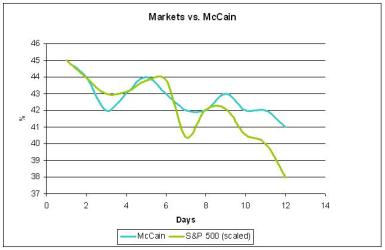
It looks like others agree with both my analogy and my conclusion. Neoconservative
columnist Charles Krauthammer wrote
on October 3rd "Once Ronald Reagan convinced America that he was
not menacing, he won in a landslide. If Obama convinces the
electorate he is not too exotic or green or unprepared, he wins as
well." And while Krauthammer doesn't agree with all of Obama's
views, he concludes "Nonetheless, he's got both a first-class
intellect and a first-class temperament. That will likely be enough
to make him president." And conservative columnist David Brooks said
said
on NewsHour October 3rd "I have always thought people would move
in the last two weeks. My model for this election has always been
1980, where people want to vote for change, they need something to
say, "It's OK, it's OK," and in the last two weeks they would make
that call. They seem to have made it earlier." Then on Oct 11th,
former Reagan advisor Ed Rollins agreed with the sentiment: "Barack
has met a threshold ... once Reagan met the threshold people wanted to
get rid of Carter and they did in a landslide." And Reagan speechwriter
Jeffrey Hart said "the two men have a great deal in common. Temperament, to be sure. And like Reagan, Obama will be a transformative president. And like Reagan, Obama is a Great Communicator, his oratory energizing people for change."
What will the final map look like?
Nov. 2: Here's my prediction: Obama wins 54% to 45% in popular vote,
and 353 to 185 in electoral votes, with a turnout of 134 million voters.
There are many electoral calculators where you can play with
scenarios. One interesting one is by Peter Seibel; it uses data from
Intrade (and thus, like Randall
Munroe's version, will be good in real time on Tuesday), but Peter's
version gives you two sliders: one to say how certain you want the
traders at Intrade to be before you call a state, and one for
"paranoia" -- you slide it one way or the other to compensate for the
Bradley Effect, cellphone voters, GOTV machines, or whatever November
surprise you want. It would be good if the slider were calibrated
with percentage of vote, but instead it is calibrated by percent
likelihood of winning at Intrade; not quite the same thing (as some
states are at 99% certainty for one candidate, but only 60% of the
vote). Anyway, on early Monday morning, the Intrade map looks the
same as mine, and it remains that way with up to 11% of paranoia
favoring McCain. Even with 34% of paranoia towards McCain, Obama
still wins 286 to 252. At 37%, Pennsylvania goes to McCain and he
finally wins. On the other hand, with 0% paranoia, Obama has 273
votes in states that are 86% or more certain for him.
Why do you support Obama?
When I endorsed Obama in the
primary elections (in January 2008), I said that there were
three key issues for the next president to fix: energy/environment
policy, restoring the US's standing in the world, and fixing the
economy. Since Jaunuary the economy has gained in relative
importance, but the three issues remain.
Energy: McCain is closer to Obama on energy/environment than any of the other Republican primary contenders was. Obama wants more and faster reductions in greenhouse gas emissions than McCain; I agree with Obama. They both propose cap-and-trade solutions, but Obama's plan does not give away the first round of permits for free. So I give Obama a clear edge, but it is hard to say exactly how each candidate would perform in office, especially as new science informs the issue and new technologies improve our options. I do think that Obama would do a much better job on fostering technological innovation. He seems to be genuinely interested in and understanding of technology (and he has the 64 Nobel endorsers). McCain seems less interested; he really is from an older generation, and he was not one of the technical innovators of that generation.
US Standing:I'm afraid the world would see McCain as more of the same as Bush, and this (when combined with our economic troubles) would lead to diminished influence of the US on the world stage. I believe Obama will do a great job of getting the US working with its allies again. Only a fresh start with a fresh party can do that; it is a bonus that reaching out to those who are different is one of Obama's strengths. Like many people, I see McCain as more likely to start a war with Iran, and I believe this would be a bad idea at a time when our military is already stretched thin. As Colin Powell said, "I strongly believe that at this point in America's history, we need a president that will not just continue basically the policies we have been following in recent years. I think we need a transformational figure. I think we need a president who is a generational change."
Economy: Most voters and analysts agree that Obama is better suited to handle the economic challenges that face us. As Colin Powell said, McCain "didn't have a complete grasp of the economic problems we have." Obama's approach has been steadier, and fits in with the recommendations of most economists. Obama also has the stronger team of advisors.
Personality: McCain is still in this race because of his maverick persona. Unfortunately, this means that when it comes time to work together on substantive issues like the economic crisis, McCain finds that he has alienated his own party as well as the Democrats. If the problem facing the US today was just to clean up some corruption in Washington and cut a couple billion dollars in pork spending, then McCain could do the job. But we're in much more serious trouble than that: trillion dollar trouble, not just billion. McCain has too many enemies and not the right temperament to build the necessary alliances. Obama can do that: he doesn't have a history of making enemies, his party is not in disarray, and he is willing to listen and compromise. McCain is more apt to shoot from the hip. As General Robert Gard said, "A few months ago, I met in a small group with Senator Obama in his office to discuss a contentious security issue. People with different, even opposite, views had been invited to attend. Obama listened carefully and asked penetrating questions, confirming my observations concerning his intelligence and temperament." That's the temperament I have seen in successful CEOs and other business leaders, and that's what I want in a president. As Gard said about McCain, "His temperament, marked not only by impatience but also by rude and sometimes hostile behavior, would discourage advisors from bringing to his attention views that might not be consistent with his preconceptions. A President with this combination of significant shortcomings would be a dangerous commander-in-chief, posing an unacceptable risk to the security of the nation."
I was able to meet Obama in 2004 and 2007 when he visited Google. For me, that was the on-site job interview, and his performance far exceeded the other candidates for the job. Hire him!
In contrast, here's McCain's visit to Google. I found it less impressive, but you can make up your own mind.
 Pageviews for this page: 71,000 through Nov. 4th.

